Sunday, March 21, 2021

More COVID Conundrums

I see in this morning's news that yesterday there were protests across Europe and the UK against continued COVID lockdowns. A quick review of the situation indicates that, at least in the UK and Germany, some restrictions were briefly relaxed, but severe lockdowns have been reimposed in the UK, with the threat of the same in Germany.

It's easy to be lulled by conditions in the US, where states like Texas, Florida, and Arizona have relaxed most or all restrictions, including mask requirements, while even in California, which has consistently been the strictest in the US, the lockdowns have eased, with indoor dining now resuming at 25% capacity in places like Los Angeles.

On March 2, Texas lifted all COVID restrictions. More than two weeks later, cases there continue to decline, although the COVID moral entrepreneurs across the country insisted at the time that this was "reckless". US data continues to indicate that there is little correlation between severity of lockdowns and prevalence of COVID infections, with the least restrictive regimes showing a decline in cases just as much as the most restrictive, like California.

Meanwhile, a Canadian visitor informs me that all worship services of any size in British Columbia have been completely banned, indoor or outdoor, since November. Religious services have been limited to ten attendees in Ontario’s “grey” zones, of which Toronto remains one, but recent lobbying efforts spearheaded by the Cardinal Archbishop of Toronto have led to the regulations being changed to allow 15% of venue’s capacity to attend a religious service.

In the US, while it took the Supreme Court to do this, indoor worship services are allowed up to 25% building capacity in areas where they were previously forbidden -- but other states now impose no restrictions at all. Notwithstandng, US cases are declining everywhere.

Also in the US, as far as I can tell, there's little public resistance to vaccines. In Europe, a substantial component of anti-lockdown protests is also anti-vax. The attitude in LA is basically gimme the darn shot, let's get on with things! The Archdiocese of Los Angeles announced that the vaccine is moral and Catholics should get it. While some groups, including African-Americans, seem reluctant to get vaccinated, this may derive from historical suspicion of medical experiments conducted on minorities -- but there is very little public resistance.

The big puzzle continues to be why COVID measures have become so disparate worldwide and in the US, but it appears that even the strictest US regimes are less severe than those in many other countries, while statistics in the US continue to improve. So far, there's been little apparent interest in studies that might examine this -- probably because the medical and philanthropic establishment that funds such studies would not like the potential result.

It suggests to me that, even as COVID restrictions have infringed unnecessarily on natural rights, constitutional protections, and the threat of retaliation at the ballot box, have continued to be more effective in the US than elsewhere.

Saturday, March 20, 2021

Kinsman's Resignation As Bishop

A visitor found this brief note in the New York Times from May 1919 referring to news that was apparently generally known at the Episcopal Church annual meeting that Kinsman was planning to retire. (He was 50.) The most visible reason he gave for his wish to retire at that time was that he seemed unhappy with his role as bishop, but he also noted that there were "deeper reasons". It also appears that his father's health, which we may speculate based on remarks in Reveries of a Hermit must have been paralysis following a fairly recent stroke, was a secondary factor.

I have a sense that oral history of how this event played out in the Episcopal Church at the time has been passed down, and I would be most interested to hear of any such accounts.

The report suggests much of this was fairly well known and understood by Kinsman's colleagues at the time. However, Kinsman seems to have kept his main motivation for resigning confidential until his formal letter of resignation, dated July 1, 1919, to the presiding bishop. This was published as a brief pamphlet in the UK in 1929 as The Failure of Anglicanism and is available on line here. In general, he summarizes positions in the 1919 letter that in later years he explains in much greater detail in Salve Mater and Reveries of a Hermit.

To the Right Reverend Daniel Sylvester Tuttle, D.D., D.C.L., LL.D., Presiding Bishop of the Protestant Episcopal Church.:

MY DEAR PRESIDING BISHOP

I hereby present through you to the House of Bishops the resignation of my jurisdiction as Bishop of the Diocese of Delaware.

RESIGNATION OF OFFICE

1 take this step with utmost regret, both as relinquishing a post assigned me by the Church to which 1 owe the greatest blessings of my life, and as sever ing my connection with the State of Delaware and its warm-hearted people, for whom during eleven years I have come to have an ever- deepening affection. The only post I could wish for myself is that of Bishop of Delaware. I resign it because I can no longer hold any post of authority in the Protestant Episcopal Church. Fuller experience which has come to me as Bishop and more thorough study of the history of our communion have forced me to abandon the interpretation of the Church's position which I held at the time of my consecration ; and 1 can adopt no other which would warrant mv continuance in office.

. . . The view of the Church's position which I have held, certainly the prevailing view in the House of . Bishops, is simply that the Episcopal Church, strong in its " appeal to antiquity," stands firmly for the doctrine of the Incarnation as contained in the Scriptures and the Creeds, and, by emphasis on its sacramental character, perpetuates the life of the Catholic Church. But I have ceased to believe and here I part company with the Bishops, and contradict my convictions and teaching in past years -that the actual facts bear out this contention. In spite of the greatest unwillingness, I have come to feel that the interpretation of the Anglican position which connects it chiefly with the Protestant Reformation is the one more consistent with its history viewed as a whole ; and that its dominant tendencies are increasingly identified with those currents of thought and development which are making away from the definiteness of the ancient Faith towards Unitarian vagueness. This would seem to me to be due not merely to local or temporary conditions but to certain informing principles always more or less apparent in Anglican history. To preserve balance and proportion of the truth, the Episcopal Churches have aimed at comprehension by compromise. I have come to believe that this habit of compromise involves increasing surrenders of truth, in spite of religious revivals aiming at stronger insistence on the ancient Faith.

But Kinsman also remarks in Reveries of a Hermit that he found his life as a bishop "wearing", and other remarks in Salve Mater suggest to me that a feature of the job he disliked was the need to reconcile the permanent divisions within Anglicanism as they manifested themselves in his diocese. The need to surrender truth to compromise, something I began to perceive as soon as I was confirmed as an Episcopalian, must have been an ever-increasing irritation. Certainly his writing after his retirement suggests he was happiest as a scholar of Church history and quite content to spend the rest of his life in seclusion.

Friday, March 19, 2021

Revisiting Cuomo's Difficulties

A few weeks ago I asked why Andrew Cuomo, of sll people, had suddenly fallen from grace amid MeToo allegations, most of them old and trivial, to the point that many New York Democrats have called for his resignation. That he ordered nursing homes to tale COVID patients. thereby spreading the disease among the most vulnerable, has been a distant also-ran in the case against him. But even there, similar allegations against Gov Whitmer of Michigan have gained little traction, much less than those against Cuomo. Why are the Democrats, enabled by media hysteria, eating their own?

I've said here that Robert Barnes is among the most insightful commentators we now have. His difficulty is that he talks in two-hour YouTube interviews with several interlocutors, and the discussions are rambling and desultory, with no transcripts. I hope something can be done about this. The problem is that Barnes is a busy attorney, and I don't understand how he even takes so many hours out of his schedule for YouTube. He would not have the time to organize, write, and polish a written column.

But earlier this week, Barnes put out the best theory I've heard on Cuomo's sudden fall from grace -- he thinks both the Newsom recall effort in California and the get-Cuomo movement in New York are spnsored by the same person, Vice President Harris, who wants to knock out potential competition for a 2024 election (or possible re-election) run. This would explan why so many Democrats are on board with the Cuomo part. Barnes says Harris was the deep state's favored candidate in early 2020, but when her campaign quickly lost momentum, Plan B emerged to place her as Vice President, with Biden resigning to elevate her when convenient.

Barnes gives no particular source for these assertions, but they do dovetail with other popular assumptions, certainly including that Biden will need to withdraw sooner than later, and that Harris is already performing functions like head-of-state calls behind the scenes. But recent polling indicates that the New York electorate is not on board with get-Cuomo: the media has so far failed to make the full MeToo stick.

However, I think Barnes errs in effectively equating the Newsom recall movement with the Cuomo MeToo. Newsom himself is largely correct in saying that the recall movement is Trumpian, but it isn't just a creature of QAnon cultists and rabid right wingers. It began as grassroots, but it's received financial support from the natioinal Republican Party. It is, in fact, part of a strategy by Reps McCarthy and Nunes to rebuild the California Republican Party, which was destroyed by Arnold Schwarzenegger, a Hollywood media figure and a Kennedy by marriage who become Republican out of pure opportunism in the 2003 recall of Gray Davis.

Whatever the outcome of the Recall Newsom campaign in a fall 2021 election, it will force the Democrats to spend heavily, while it will build enthusiasm among Republicans while generating mailing and donor lists for 2022 and 2024. It will also be a testbed for new electoral strategies endorsed by McCarthy and Nunes aiming to beat the Democrats at their own game with techniques like ballot harvesting and running attractive minority candidates. This is simply not the same thing as the intramural effort to knock out Cuomo as a potential threat to Harris, which is only a short-range intramural strategy.

Thursday, March 18, 2021

Some Additional Biographical Details On Kinsman

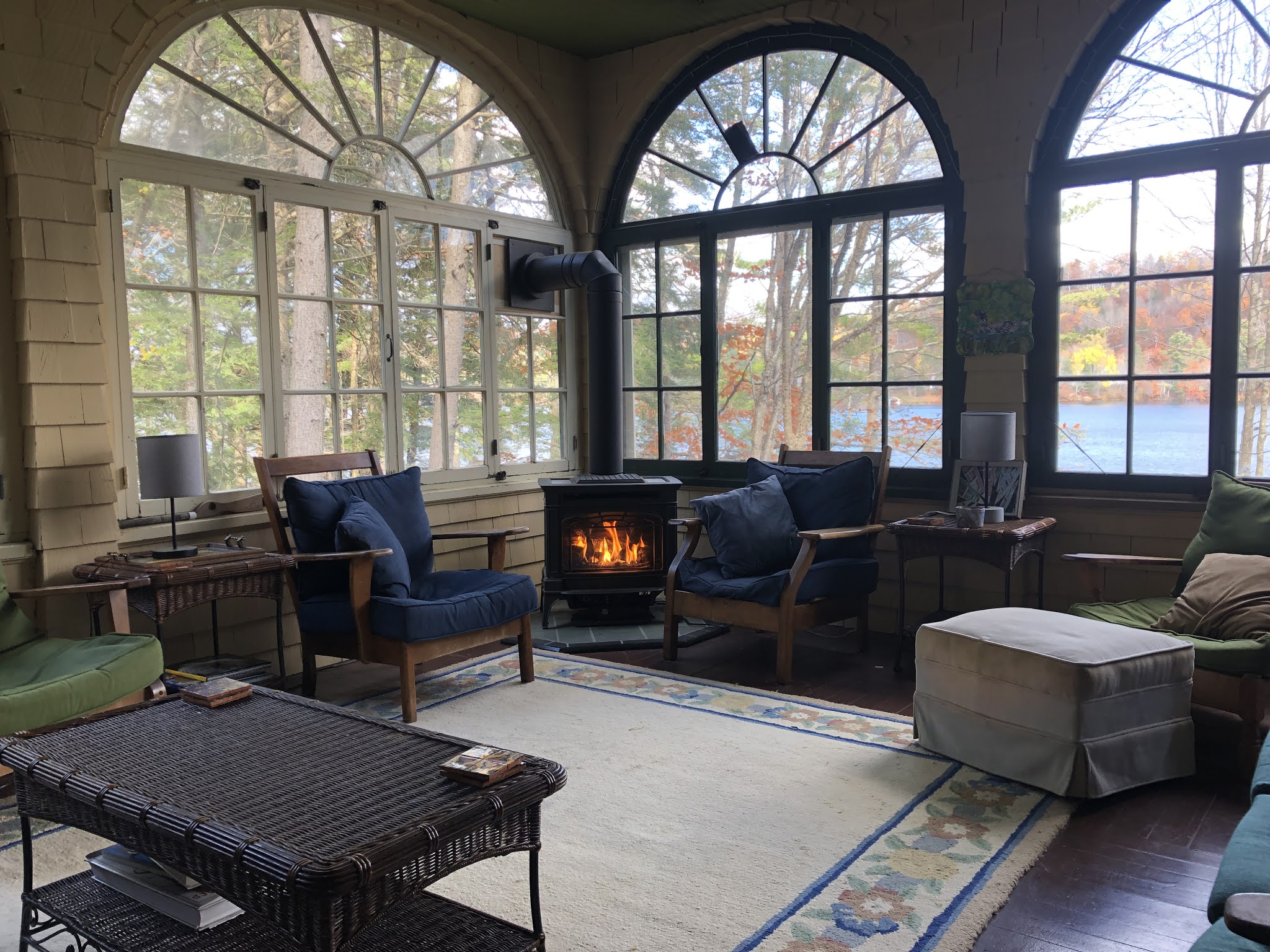
Above is a photo of the residence on Kinsman's Maine estate, Birchmere, which currently operates as a bed and breakfast. There are other photos at the link. You can rent the place for $490 per night. A Facebook post indicates the place had been vacant for some years prior to 1985, and its current condition reflects considerable renovation, so that very little of the interior would be how it was when Kinsman lived there. If I had the means, I'd certainly want to stay there now.

At the time Kinsman lived there, the place could be reached only by boat across the pond. There is now a four-wheel-drive accessible road. Kinsman also built a tower on the property that later served as a mausoleum for him and his family. At this point, I can't locate any photos of the tower/mausoleum on the web. This appears to be where he did his studying and writing.

Census data indicates that both of Kinsman's parents and his sister lived in the Wilmington, DE bishop's residence in 1910 when he was bishop there. However, the 1900 census shows only his mother and sister living with him in the rectory at St Martin's parish in New Bedford, MA. His father in that census was living in the patriarchal home on Mahoning Ave in Warren, OH, which at that time was owned by his brother Thomas. Thomas's wife and another brother, Charles, also lived there at that time. Frederick Jr's occupation was listed as banker. The reason for the separation is not known, as Frederick Jr's death certificate shows he passed away in Maine and was still married to Frederick Joseph's mother. (Click on the image for a larger copy.)

Wednesday, March 17, 2021

Kinsman's Americanism and Catholicism

This book is one of Kinsman's works that's available on line in downloadable form. Almost exactly a century after its 1926 publication, this is a tough book to parse, in part because the issues that seem to have started Kinsman's train of thought are in some ways now moot. The wave of Catholic immigraton that took place in the post-Civil War period ended in the 1920s, while the decline of Main Line Protestantism that Kinsman anticipated has largely taken place.

However, I think the main force of his argument is still relevant, and even relevant to current circumstances. His concern, from the perspective of his recent conversion and sudden change of life from the peak of Protestant respectability to association with Catholic immigrant hordes, seems to have brought him to the question of how the hordes, and the Church that largely arrived with them, can integrate into Protestant American society. And let's keep in mind that he speaks quite consciously as someone whose family arrived, both literally and figuratively, on the Mayflower.

So he first argues that Catholicism is based on the same natural-law principles as those the founders wrote into the US Constitution. Catholicism carries with it the responsibility for Christians to obey the secular laws and support the secular state; Catholic authorities govern the area of faith and morals exclusively. And as a practical matter, Catholic immigrants have enthusiastically entered American life. But I think Kinsman was focusing even more on the future.

It is true, that Americans of the older stocks are becoming comparatively less numerous and in- fluential; that every year some lines of colonial descent become extinct. It is wholly probable that the descendants of later emigrations will eventually count for more in the country than those of the earlier; that there will be great changes in the proportions of the mixed ingredients of American blood. Yet the Americanism established by men of the earlier periods survives and is likely to survive. (p 13)

To this end, the book moves increasingly to the question of what will replace the 17th and 18th century versions of Protestantism, because, as he said in Salve Mater, these are bound to lose relevance.

The last four hundred years have seen a steady drift away from what is definite in Christianity. The various bodies which broke from the Church in the sixteenth century inaugurated changes which marked not fixed degrees of departure from mediaeval Christianity, but a process of gradual abandonment. This has been steady and continuous, sometimes unconscious, sometimes concealed by pleas for reconstruction and reinterpretation, sometimes deliberately devoid of every disguising pretence. The test-case is that of belief in the Godhead of Christ. There have been all degrees of confusion, hesitation, and explicitness of denial, and always vehement defenders of the truth. Yet the drift away from belief in Jesus as God among all classes of non-Catholics has become more rapid and overpowering, too strong even for the strongest swimmers caught in these side-currents. Abandonment of old Christian beliefs and practices is held to be alone worthy of modern thought; and what started as "justification by faith" is ending as justification of little or no faith at all. (pp 161-162)

The current situation, in which we're operating in a post-Main Line Protestant world, presents a new set of challenges to the Church. I think Kinsman foresaw the impact of Protestant abdication, but he couldn't foresee in any detail the precise conditions that would prevail when it finally became effective.

But I think he did foresee the need for the Church to assert itself as something beyond a cultural artifact that certain immigrants brought with them from the Old World. I think this is a strategy that figures like Bp Barron, whom pre-Conciliarists treat with great suspicion at best, are nevertheless beginning to articulate.

Tuesday, March 16, 2021

Cleaning Up Frederick Joseph Kinsman's Biographical Record

The photo above is the second of two provided by a visitor of Kinsman from the St Paul's School website. It shows him as a master at St Paul's, which he was up to 1896, when he was ordained an Episcopal priest. Born in 1868, he would have been in his mid-20s at the time of the photo.

A difficulty in tracking down biographical information on Frederick Joseph Kinsman is that both his father and grandfather were named Frederick Kinsman as well. Due to this problem, I erred in an earlier post here in saying that Frederick Joseph was the son of a Cleveland judge. Judge Frederick W Kinsman (1807-1884) was actually Frederick Joseph's grandfather, a prominent citizen of Warren, OH. In 1832, his father-in-law built him a house on "Millionaire's Row" in Warren as a wedding gift. The house is preserved as a historical exhibit. Kinsman's first wife died young, and their children all died in infancy. His second wife was Cornelia Pease Kinsman.

Their children were John Kinsman, Thomas Kinsman, Charles Pease Kinsman, Henry Perkins Kinsman, and Frederick W Kinsman Jr, born in 1841. Frederick Jr presumably grew up in the now-preserved Kinsman house at 303 Mahoning Avenue, Warren, OH, but ownership appears to have passed to another of Frederick Jr's siblings, and the 1880 census says that Frederick Jr's family, which consisted of his wife, Mary Marvin Kinsman, his daughter Cornelia, and his son Frederick Joseph, lived on Washington Ave in Mahoning. Frederick Jr's occupation in that census was listed as "manufacturer".

We know little else of Frederick Jr. At the time of his death, he was 81 years old, and based on the brief reference in Reveries of a Hermit, by the tmie of his death, he was paralyzed, but we know nothing else of his condition or its cause. I found this obituary in the Brooklyn Tablet from January 1922:

I assume this obituary was written and placed by Frederick Joseph's sister, Cornelia, who seems to have been his companion throughout much of his life. She also probably wrote and placed this 1934 obituary for his mother:
Of note is that she died in the Hospice Marcotte in Lewiston, ME which is an elder care facility to which Frederick Joseph and Cornelia moved in 1936. In addition, it mentions that Mrs Kinsman lived in the bishop's residence while Frederick Joseph was Bishop of Delaware. We know that his sister Cornelia also lived there during that period and may have served as his hostess. A visitor has determined from census records that Mrs Kinsman also lived with her son when he was rector of St. Martin's Church, New Bedford, MA, which suggests this living arrangement must have continued throughout much of Kinsman's life.

Whether his father, Frederick Jr, lived with his wife, son, and daughter during this period is unclear, and it's also completely unknown when, and for what reason, he became paralyzed. It's entirely possible that his condition required him to be hospitalized separately from the family.

Frederick Joseph's life is fascinating in some measure due to what we don't know. I note that the experience of blogging on figures like Cardinal Law has in fact caused knowledgeable parties to come forward. I certainly hope this may be the case here.

Monday, March 15, 2021

Frederick Kinsman And Cancel Culture

A visitor found the photo above of Kinsman as a student at St Paul's School in Concord, NH. This is actually a key part of his background, as he makes clear in Salve Mater that the Kinsmans were a pominent Ohio family, There's a Kinsman Road and a Kinsman district in Cleveland. That Frederick would attend St Paul's School, one of the St Grottlesex group, and become an Episcopal bishop are indications of his and his family's high standing in society.

Kinsman's literary product as a Catholic is complex, and with much of it available to me due to the generosity of a visitor, I'm finding it deserves detailed reading and reflection. Reveries of a Hermit is an example. About half of it is the closely reasoned apologetic I've discussed here, but there's a Part II which is about the same length but more difficult to parse. It sets out to be an essay on three saints connected with the ancient city of Ephesus, but in the middle, there's a chapter on Birchmere, Kinsman's estate in Maine, where he lived in seclusion with his parents and sister following his resignation as Bishop of Delaware in 1919.

This chapter gives some biographical insight into how his conversion to Catholicism affected his personal life.

In 1919, a change in religious, or rather ecclesiastical, convictions which had hitherto deternmined my course in life, involved abandonment of occupation and environment which had formed framework and background for life to the age of fifty, and a series of fresh starts for what years might remain. The claims of my family were, in some ways, paramount in determining future courses, chiefly the condition of my father, who was helpless with paralysis. Birchmere was our only, and the only possible, home, and owing to my father's condition, it was evident that he and I at least must live there all the year round. (pp 200-201)

Kinsman's father, who had been a prominent Cleveland judge, passed away in 1921. This is the only reference I've found in some amount of searching to his illness; no obituaries have so far come to light despite the family's prominence. One working hypothesis so far is that the effect of Frederick's conversion and resignation as bishop was far more cataclysmic for the family than any had anticipated, and I would not rule out his father suffering a stroke in consequence.

The evidence in the Birchmere essay suggests that Kinsman was shunned by his former associates and friends, to the extent that we would now call it canceled.

The middle half of my life was a crowded time, full of interests, varied experiences, congenial companions. I was socially inclined, could have intercourse with many people of many kinds, and was most fortunate in those with whom I had close association. The change of 1919 ended this. Henceforth, I was to be separated from all but a few old friends, alienated from many -- though the alienations have lessened with years. (pp 203-204)

Kinsman's 1944 obituary in a St Paul's alumni publication suggests, however gently, that many of his schoolmates felt he lost his mind in 1919. I suspect the degree to which the society in which he swam seems to have regarded his conversion as something like outright betrayal came as a great surprise, both to him and perhaps more to his family, who may have been shunned just as much.

The visitor who sent me a copy of his Americanism and Catholicism (1924) expressed some puzzlement about Kinsman's direction in that book. I've been through it once, and I need to reread it. I think it's an attempt on his part to think through what seems to have been an unexpectedly angry reaction to his conversion -- an Episcopal bishop in the early 20th century was an unquestionable pillar of respectable American Protestant society, and for him to renounce that position in favor of Irish, Italian, and Slavic immigrants would have amounted to betrayal of their core values.

It's worth noting that the next Episcopalian bishop to resign and convert to Catholicism was Jeffrey Steenson, almost a century later. The impact of Steenson's resignation was imperceptible; it wasn't news outside the speicalized Anglican and Catholic press. I think this is largely because, as Kinsman himself predicted, Main Line Protestantism in the US has run its course, and its cause has merged with more general Agnosticism. To cease to be a Protestant is simply no longer an act of betrayal, which it was in Kinsman's time.

But this is not to say that the Establishment no longer exists, that it no longer has great power, and that it no longer takes vicious revenge on those it perceives as betrayers.