Tuesday, February 8, 2022

What Can Men In Black Teach Us About Meritocracy?

My thinking abouit trhe Penn women's swim team has inevitably brought me back to the selection scene at the beginning of the whole Men in Black franchise. For those who aren't familiar with it, the premise of the series is that the space aliens have already arrived, but the government has worked out a super-secret agreement with the aliens to let them stay on the planet if they're careful to stay out of sight. The job of the Men in Black, an ultra-secret, ultra-elite cadre, is on one hand to enforce the agreement with the space aliens, while on the other to act as a cleanup crew in cases where the aliens have inadvertently revealed themselves to ordinary people.

It goes without saying that anyone tasked with making sure the space aliens stay quiet and out of sight, as well as cleaning up situations where they don't, must have extraordinary tact, intellect, skill, and initiative. At the start of the first Men in Black film, Agent J, played by Will Smith, has unknowingly applied to be a member of this team. How he's selected gives an indication of how merit ought to be selected, even if the real world falls far short of this ideal.

Agent J arrives late to the selection session, in which it's explained that the government is looking for "the best of the best of the best". His fellow applicants are clearly the cream of the government's best, Navy SEALs, honors graduates of the academies, Marines, and the like. Agent J, in contrast, performs a series of gaucheries. His first test is to find a way to fill out his application when no desk or table is available to any of the elite applicants. Agent J is the only one to see the coffee table in the middle of the group and noisily pull it to himself, the only possible way to accomplish the task.

At the conclusion of the test, Agent Zed, who's conducting it, announces to the military meritocrats who feel they've made all the right moves, "Gentlemen, congratulations. You're everything we've come to expect from years of government training." Expecting one of their group to be selected, they're instead led off to an "eye test", which Men in Black savants will recognize is a device that wipes their memories of all recent events. Agent J is selected.

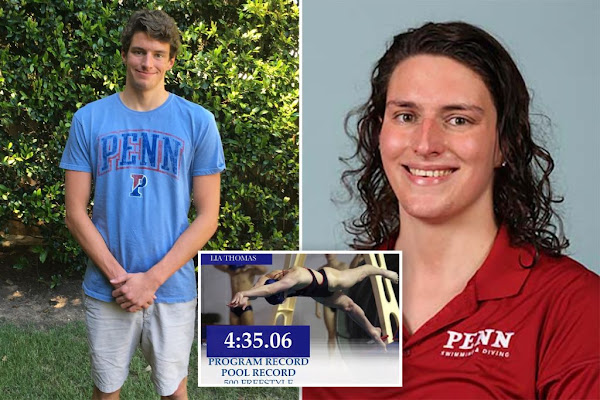
Over the past several days, I've thought and thought about this episode vis-a-vis the Penn women's swim team. I would go so far as to say that for them, this is a test very much equivalent to Agent J's selection process, but in their case, there's no Agent J. Or if there is one, the winner is Lia Thomas. The Penn women's swim team is, after all, everything we've come to expect from the Ivy selection process, the best of the best of the best. And their potential employers, or perhaps the Olympic teams they might hope to join, are fully entitled to expect the same. The top-tier law firms will happily recruit them as associates down the road given their flawless records. They will never commit the remotest gaucherie.

Except that, confronted with what must be in at least some cases, the ony serious challenge they may have had in the successful progress of their lives in the form of a wild-card competitor, a male impersonating a female, none has come up with an effective counter strategy -- not even, as our Roman Catholic parish clergy might advise if asked, to pray, seek out a Plan B, and leave the team if that's the path that presents itself. I hear a number like 36 as the total women's team membership presumably including Thomas, the guy.

Of the 36, or maybe 35 women, 16 have gone so far as to enlist a spokesperson to write a letter on their behalf, allowing them to keep quiet and out of sight, a little like the space aliens have been told to behave. This has been met with silence from Penn; they needn't have bothered. Several others, just as anonymous, have written the administration to say that they're tickled pink that Lia has had such a wonderful opportunity, and they're copacetic with the whole program.

Of the 35 women, I have the impression that none is going to find a solution that will be remotely satisfactory for herself, sacrificing a sense of justice or even plain common sense to an illusory idea of a future career that's likely to be just as unsatisfactory. None seems willing to come out of the shadows and identify herself by asking for simple justice, either reporting the indecent exposure to law enforcement or reporting the sexual harassment to the designated campus authority. That way, I have a feeling, leads to issues like ulcers, cancer, or alcoholism down the road. Just sayin'.

The real elites here are the people who are running the show, the ones who must certainly have put Lia Thomas up to the stunt and paved the way for it over a period of years. Remember that Thomas began transitioning nearly three years ago and must certainly have done it with the assurance they'd have a place on the women's team. But even to start nearly three years ago means the assurance had to have been in place well before that. The game was well and truly rigged before most of the women swimmers arrived on campus their first year.

The people who set that plan in motion are the real elites, the ones who control the hazing. The Penn women swimmers are just the best of the best of the best, the hazees. They don't have the remotest idea who the real elites are, nor the remotest idea of how to counter them. They'll spend their lives doing as they're told, which is the point.

Monday, February 7, 2022

The Ivy Dilemma

Unfortunately, while the acounts I've linked of the Penn women swimmers' dilemma outline their near-impossible choices very clearly, my sympathy extends only so far. The conventional wisdom is that the swimmers are being denied the chance to compete fairly in women's competitions by allowing a male swimmer to skew the results, and on top of that, they're being subjected to sexual harassment when the male exposes his genitals in the women's locker room. But if they complain -- indeed, if they go even so far as to report the indecent exposure to law enforcement or follow policy and complain to the campus sexual harassment coordinator -- they face loss of scholarship, dismissal from the team, and loss of future career prospects.

But this is simply a microcosm of the larger Ivy dilemma, which has been around since the late 1940s when the Ivies became selective and at least in theory "meritocratic". At least, David Brooks thinks that way. The more or less direct effect of this was to create a rat race for the suburban middle class and their children; the media stirred up a need for families to have their children attend "the college of their choice", which was just a way of saying an Ivy. The route to this was felt to be via SAT scores, grades, and extracurriculars, an intense and consuming effort that began during the elementary grades.

I recall during my own early teens I was beginning to display behavioral problems in school that caused Dr Callahan, the middle school principal, to call my parents in for a conference. I'm not entirely sure if my parents even told me about this before they went in. Indeed, the odd thing was that the person who said the most to me about it was Dr Callahan, who called me in the next day, shaking his head.

"You need to understand something," he told me. "Your parents are . . . panicking. They're focused completely on how you can get into the college of your choice. They're ignoring everything else." The impression I have in hindsight is that whatever issues in my behavior may have caused Dr Callahan to call my parents in for a chat, it appears my parents' attitude must have struck him as some cause of the problem itself, and any attempt to reason with them was impossible.

The "college of my choice" was Dartmouth, about which I knew nothing. As it happens, the day I was born, my father called them to see if he could enroll me at Dartmouth right then. Trust me, I know from college admissions rat race.

Several aspects of the Ivy experience have stayed with me. I remember an odd discussion in our dorm lounge one night in which several Dartmouth faculty turned up to lead a discussion on "cognitive dissonance". They cited psychological experiments in which subjects were told that they were about to have a "meaningful" or "valuable" experience, but then were subjected to various levels of meaningless and progressively unpleasant activity. The result was the more unpleasant the meaningless activity, the more "meaningful" and "valuable" the subjects rated it.

The professors went so far as to compare these results to the Ivy admissions process -- that the meaningless and unpleasant activity of compiling a successful admissions dossier enhanced the perceived value of the Ivy experience. (They didn't day so, but my own view has been that the Ivy undergraduate experience is itself a meaningless and unpleasant hazing -- I need point only to the Penn women swimmers forced to tolerate a man exposing his genitals. Penn's position appears to be that this is a meaningful and valuable experience as well.)

But what about those professors who conducted the dorm lounge discussion? They were telling us right out that we'd been manipulated into thinking we'd successfully negotiated a difficult, but meaningful and valuable gauntlet, and that this said something good about us. Didn't this say something about those professors as well, that they themselves were complicit in a cynical and manipulative process? Apparently the subtext of the whole discussion was that you're being screwed, relax and enjoy it.

My own reaction to the Ivy undergraduate experience was effectively to tune out. It was just as well; for at least 20 years after I graduated, my main intellectual preoccupation was discovering the need progressively to unlearn all the comfortable certainties I'd been taught there.

The problem for the Penn women's swimmers is that they've been caught in some version of the hazing that makes up the Ivy experience for just about everyone. Hazing is bad and unjust. Colleges generally have anti-hazing policies that they observe about as faithfully as their anti-sex harassment policies; such things notwithstanding, pledges and teammates still routinely pass away from hypothermia or alcohol poisoning from hazings that theoretically don't take place.

The Penn women's swimmers have been convinced that at the end of this process lie successful careers, successful lives. Much as they hate the hazing, they're going to put up with it. Things must certainly get better; they shouldn't rock the boat. The problem is that this isn't an education. Nothing remotely close. The people who might actually benefit from an education there are almost certainly not the ones on the women's swim team. By the time they find themselves in that sort of dilemma, they're already a lost cause.

Sunday, February 6, 2022

More Penn Pushback

This story at Breitbart expands on another story at the Washington Post that fleshes out the circumstances of the letter that 16 members of the Penn women's swim team (also mentioned here) sent to university authorities requesting that they not sue USA Swimming over its new trans criteria. According to the Post,

Thomas’s teammates did not identify themselves in the letter. It was sent by Nancy Hogshead-Makar, a 1984 Olympic swimming gold medalist, lawyer and chief executive of Champion Women, a women’s sports advocacy organization. She said in a telephone interview that she sent the letter on the swimmers’ behalf so they could avoid retaliation; in the letter, the swimmers claim they were told “we would be removed from the team or that we would never get a job offer” if they spoke out against Thomas’s inclusion in women’s competition.

The Breitbart story interviewed a second expert, Natasha Chart, whom they characterize as "a feminist who argues that women’s particular legal rights and social status depend on the public’s recognition that women’s bodies are fundamentally different from men’s bodies", who raised an additional point:

Consider what else is happening here. Lia Thomas is reported as [committing] basically what would be regarded as indecent exposure. He’s fully undressing in their locker rooms, so he’s displaying sexual power. This is endorsed by all of these [pro-transgender] elites, and the women who are being allowed into the elites have to put up with — or endorse — this sexual abuse of other women in order to be accepted.

Breitbart also quoted a letter sent February 1 by two feminist organizations, Women’s Declaration International, USA, and Keep Prisons Single Sex, to a wide range of Penn and local law enforcemernt officials:

We are writing to report a potential violation of Pennsylvania Code of Law Section 3127 and of Title IX and of the University of Pennsylvania’s Sexual Harassment, Sexual Violence, Relationship Violence and Stalking Policy. . . . It appears from news reports that many, if not most, of the female athletes on the University’s swim team fear retaliation and are concerned about maintaining their scholarships and reputation in the community. For this reason, a report such as this one should be considered an adequate basis requiring law enforcement and the university to conduct an investigation without any female members of the swim team having to make an individual direct report themselves.

The letter cites Pennsylvania Code §3127 Indecent exposure:

A person commits indecent exposure if that person exposes his or her genitals in any public place or in any place where there are present other persons under circumstances in which he or she knows or should know that this conduct is likely to offend, affront or alarm.

The letter continues,

Based on the news report [linked here in a previous post], Thomas has exposed his genitals in a place where it appears Thomas knows or should know that this is likely to offend. Further, based on this news report, a University of Pennsylvania employee, the women’s swimming coach, has been explicitly informed that the women are offended, affronted or alarmed by this. Rather than taking steps to further report and address this, according to this report, the female athletes of the University of Pennsylvania have been told that they must accept this harassment and indecent exposure.

The letter then quotes Penn's own sexual harassment policy, which contains the usual, and concludes,

Should there be any future litigation on this matter, the news reports, including the one cited here should be sufficient to have put the University of Pennsylvania on notice that there were reports of multiple female students being subject to harassment and sexual misconduct while engaged in a sanctioned student activity. According to your own policy, you are obligated to investigate this. You know the names of these female students. You know there are reports that they fear retaliation. For this reason, the initiation of any investigation and remedial action should not require a report directly to you by one of these impacted students.

My wife, a retired attorney, is astonished that nobody on Penn's legal staff appears to have raised these issues even before the February 1 letter. It seems to me that a minimal response to Penn's potential exposure in this case would be either to require that Thomas change in the men's locker room, or to carve out a separate locker room exclusively for transsexual team members, but of course, either solution would undermine the whole message Penn is trying to send, that men and women are interchangeable, gender is just a social construct, and Penn is entitled to enforce this. (Penn's endowment is $20.5 billion, so a few partitions and an extra shower should be affordable and a matter of a weekend's work.)

According to the Post, Penn so far has not responded directly to any of the complaints.

I've got to assume that since this is the Ivy League, there have likely already been quiet attempts by swim team parents and others to resolve this without publicity, but since this is the Ivy League, this is as serious as a Brooks Brothers tie, and Penn will not go quietly. They'll be on the hook for multimillion-dollar settlements, if you ask me. Plus various and sundry resignations.

Saturday, February 5, 2022

COVID Fatigue

My wife and I throughout our marriage gave up wine for Lent, at least up until 2020, when along with a considerable slice of the world population, we found that wine was essential therapy for lockdowns, social distancing, masks, and the rest of the COVID madness. The other day we raised the question of whether we were ready to go back to giving it up for Lent this year and almost instantly decided no way. 2022 looks like not the beginning of the end, but at least maybe the end of the beginning.

What we're seeing is widely divergent policies worldwide on how to end the crisis, especially in the face of a general acknowledgement by all but the usual suspects that lockdowns, masks, social distancing, and even vaccine mandates have been either ineffective or counterproductive in combating the pandemic. An essay by Michael Bang Petersen, an adviser to the Danish government in its decision to end all COVID restrictions, makes an important point:

Our research has shown that public trust has taken a hit in many countries, including Denmark. As fatigue, personal costs and miscommunications have accumulated, the public has become wary. Until recently, the people losing the most trust have been those who felt that their governments’ responses were too heavy-handed. However, according to our data, the Omicron wave has also chipped away at the trust of those who have been supportive of their government’s approach up until now. Lifting restrictions while cases are soaring can seem like betrayal after two years of seeking to “flatten the curve.”

The key ingredients of an effective pandemic response — communication, trust and a shared sense of threat — are slowly dwindling. This can lead to social strife and will make it harder for leaders to steer their populations out of the crisis.

For two years people have debated the value of masks, vaccine passports and more, to the point that they are no longer opinions but identities. And when opinions become identities, they warp our understanding and make it harder to change one’s mind as the situation changes. The truth is that we are all biased. For example, research shows that in the United States, Republicans tend to overrate the risks of getting vaccinated, and Democrats tend to overrate the risks from the disease.

. . . Because Covid-19 vaccines are effective in preventing severe disease from the virus but less effective in preventing infections, the continued spread of the coronavirus in highly vaccinated populations will become a Rorschach test: Everyone will see something different. People who remain worried about getting Covid-19 will see high cases during surges, which will justify their concerns and strengthen their own observance of mask-wearing and distancing. Calls for removing restrictions will seem dangerous. People who are less vulnerable to infection will focus on the lessened severity and do the opposite. They may view calls to keep restrictions in place as unnecessary and infringing on their freedoms.

For people who have been highly vigilant about Covid-19, the end of the pandemic could end up feeling like defeat. At some point, it will be time to lift restrictions and lower the guards. The people they’ve been debating about masks or whether the crisis is improving will then be right. It won’t be because this position was always correct, but because the circumstances have changed.

That’s why strong leadership is so critical for ending the pandemic. As the need for restrictions lessens, it’s up to public health and political leaders to explain why restrictions are being lifted, just as they had to explain why they were being imposed in the first place. Authorities must tell the public why they are placing more responsibility on individuals and, ideally, address the concerns of those who may not be ready, as well as those who remain at higher risk, like the immune compromised.

Dr Petersen is very astutely sending the message that it's time for the public health authorities to declare victory and get out. This won't be an easy process. We're going to need our wine for the foreseeable future.

Friday, February 4, 2022

Penn And The NCAA Are Not On The Same Page

There's been a looming problem for Penn, Lia Thomas, and the Ivy League throughout the bizarre trans swimmer saga -- the NCAA, which represents many schools that, unlike the Ivies, rely heavily on their athletic programs for both serious ticket income and alumni donations, isn't quite ready to open women's sports to male competitors on the same basis as the Ivies. Last month, it tried to duck the controversy by changing its policy and deferring decisions on trans competitors to the individual sports' oversight bodies.

The NCAA Board of Governors on Wednesday [January 19] voted in support of a sport-by-sport approach to transgender participation that preserves opportunity for transgender student-athletes while balancing fairness, inclusion and safety for all who compete. The new policy, effective immediately, aligns transgender student-athlete participation for college sports with recent policy changes from the United States Olympic and Paralympic Committee and International Olympic Committee.

This past Tuesday, USA Swimming, the relevant oversight body in this case, issued its own guidelines, which are now effective for NCAA competition. These guidelines as written would prevent Lia Thomas, the six foot-four fully intact male swimmer, from competing in the upcoming NCAA championships:

On Tuesday, USA Swimming announced that competitors in women’s events must have recorded low levels of testosterone for 36 months; the previous rule required only one year. Thomas began “transitioning” in May 2019.

The specific policy "will be implemented by a decision-making panel comprised of three independent medical experts and eligibility criteria will consist of:"

Evidence that the prior physical development of the athlete as a male, as mitigated by any medical intervention, does not give the athlete a competitive advantage over the athlete’s cisgender female competitors.

Evidence that the concentration of testosterone in the athlete’s serum has been less than 5 nmol/L (as measured by liquid chromatography coupled with mass spectrometry) continuously for a period of at least thirty-six (36) months before the date of application.

There were immediate complaints about the policy change, although it isn't completely clear how it would actually affect Thomas's participation in the March NCAA championships.

Some advocates on Twitter argued that USA Swimming targeted Thomas in particular.

“This was a decision SOLELY to eliminate Lia Thomas from the team,” one person said.

Prior to the announcement, Penn was already considering a lawsuit against USA Swimming if its policy prevented Thomas from competing:

The University of Pennsylvania is considering a lawsuit if Lia Thomas is barred from competing in the upcoming NCAA women’s swimming championship, according to a report.

A swimmer on the Penn women’s team, speaking on the condition of anonymity, claimed to Fox News that administrators were considering legal action if Thomas is prohibited from participating in the championship.

“I have a feeling that if USA Swimming changes their rules, they will be filing a lawsuit for Lia to swim, but they wouldn’t do that for us,” she said. “That’s just really upsetting.”

As of this morning, the NCAA is going to get involved again, even if it deferred the decision to USA Swimming last month:

The NCAA will review the transgender policy recently implemented by USA Swimming prior to the women’s NCAA Championships next month, making it possible the new guidelines will be adopted by the organization ahead of the competition which begins on March 16.

. . . The Board of Governors aren’t scheduled to meet again until April, but Dent said they could possibly meet remotely prior to the start of the NCAA Championships.

The need for an updated policy has come to light amidst the ongoing transgender discussion in the sport, sparked by the performances of Lia Thomas, a trans woman, who competes for the University of Pennsylvania in the NCAA.

. . . On Thursday, a group of 16 members on the Penn women’s swim team sent an open letter to the Ivy League and the University of Pennsylvania asking them to follow USA Swimming’s policy and not partake in legal action with the NCAA.

Clearly the situation is fluid, but I have a sense that the NCAA doesn't want new controversies that would threaten the bottom line of big time collegiate sports in the same way that other manifestations of wokeism have hurt the finances of pro football and basketball. The basic problem is that sports fans don't buy this stuff and won't pay to watch it. I would guess the NCAA understands this.

Thursday, February 3, 2022

Words Of Wisdom From The Late Rush Limbaugh

Due to the talk radio format he used, you often had to get lucky and hear him on the right hour and the right day to catch his most cogent thinking. (I think as well that he reached his peak eight or ten years ago.) But one set of remarks among several has stuck with me. I believe it was during the 2012 Sandra Fluke controversy, when he railed against

contraceptive mandates which included statements labeling Georgetown University Law Center student Sandra Fluke as a "slut" and "prostitute". Limbaugh was commenting on Fluke's speech the previous week to House Democrats in support of mandating insurance coverage for contraceptives. Despite disapproval from major political figures, Limbaugh made numerous similar statements over the next two days, which led to the loss of several of his national sponsors and Limbaugh apologizing on his show for some of his comments.

Limbaugh recovered from this setback and then some, as he did throughout his career. Remarks on his show during that particular kerfuffle reflected both his confidence and his insight. He said at the time words to the effect that if the media creates you, the media can destroy you. On the other hand, if the media didn't create you -- as he felt was the case with himself -- the media can't destroy you. He ended his career receiving the Medal of Freedom on his deathbed.

This applies in particular to Jeff Zucker, a Harvard alum:

Between January 2013 and February 2022, Zucker was the president of CNN Worldwide. Zucker oversaw CNN, CNN International, HLN, and CNN Digital. He was previously CEO of NBCUniversal. Zucker served as an executive in residence at Columbia Business School.

. . . He was a captain of the North Miami Senior High School tennis team, editor of the school paper, and a teenage freelance reporter ("stringer") for The Miami Herald. Zucker also was president of his sophomore, junior, and senior classes, running on the slogan "The little man with the big ideas." He graduated from North Miami Senior High School in 1982. Before college, he took part in Northwestern University's National High School Institute program for journalism. Zucker went on to Harvard University. He was president of the school newspaper, The Harvard Crimson, during his senior year. As such, he encouraged the Crimson's decades-old prank rivalry with the Harvard Lampoon, then headed by future NBC employee Conan O'Brien, which culminated in Zucker having O’Brien arrested. Zucker graduated from Harvard in 1986 with a Bachelor of Arts in American history.

In 1989, he was a field producer for Today, and at 26 he became its executive producer in 1992. He introduced the program's trademark outdoor rock concert series and was in charge as Today moved to the "window on the world" Studio 1A in Rockefeller Plaza in 1994. He is credited with managing the show during its most successful years and launching it into its 16 years of ratings dominance.

. . . In 2000, he was named NBC Entertainment's president. A 2004 BusinessWeek Profile stated that "During that time he oversaw NBC's entire entertainment schedule. He kept the network ahead of the pack by airing the gross out show Fear Factor, negotiating for the cast of the hit series Friends to take the series up to a tenth season, and signing Donald Trump for the reality show The Apprentice. He is credited with the idea to extend Friends episodes by 10 minutes and convinced the cast to extend their contracts by two years. The Friends era was one of the most profitable ever for NBC. The Zucker era produced a spike in operating earnings for NBC, from $532 million the year he took over to $870 million in 2003."

. . . In 2010, in response to a public controversy over the network's reported rescheduling of late-night hosts Jay Leno and Conan O'Brien, Los Angeles Times reporters Meg James and Matea Gold wrote that Zucker's tenure had led to "a spectacular fall by the country's premier television network" and dubbed the intra-network feud and subsequent public relations fallout "one of the biggest debacles in television history". Under Zucker NBC fell from being the number one rated network to the lowest rated of the four broadcast networks and was occasionally being beaten in the ratings by programming on some of the more popular cable channels.

Days later, The New York Times columnist Maureen Dowd wrote that in Hollywood "there has been a single topic of discussion: How does Jeff Zucker keep rising and rising while the fortunes of NBC keep falling and falling? ...many in the Hollywood community have always regarded him as ...a network Napoleon who never bothered to learn about developing shows and managing talent." She explained that Zucker "is a master at managing up with bosses and calculating cost-per-hour benefits, but even though he made money on cable shows, he could not program the network to save his life."

After he moved to CNN, things peaked and then began a decline. A data point nobody has mentioned in discussing yesterday's ouster is this one in the Wikipedia entry:

On February 2, 2021, Zucker announced he would step down [as president orf CNN Worldwide] at the end of the year. In August 2021, however, it was reported that he did not plan to leave until the completion of the merger of WarnerMedia and Discovery, Inc.

So let's get real. He was already on his way out at CNN, was theoretically going to leave at the end of last year, and effectively extended his tenure by all of a month, except that by resigning under allegations of sexual harassment, he probably will lose at least some part of what would have been a generous golden handshake if he'd just left a month ago the way he was supposed to.

What strikes me, though, is how applicable Rush Limbaugh's insight is here: the media created Zucker, and the media destroyed him. Zucker was what Bp Barron would call a contingent being; he owed his existence to someone else. Speculation this morning is that Zucker's departure so far is being attributed to what one observer called an "HR technicality"; viz, an undisclosed "consensual relationship" with a colleague. My guess is that someone in the new management over CNN already had Zucker's number, and the wheels were in motion even before the Cuomo crises raised any questions about hanky pank.

Somewhere El Rushbo is laughing.

Wednesday, February 2, 2022

Nobody's Keeping Score On Ukraine

Every time I see Ukraine news, I have to force myself to remember that we had one presidential impeachment over a Ukraine phone call and another instance where Joe Biden bragged about his influence there. During Joe's vice presidency, his son Hunter served on the board of a Ukrainian energy company, Burisma. And throughout this period, Russia has had annexation of parts or all of Ukraine on its agenda, which also affects US policy.

But I find very little anywhnere tht tries to parse this out, especially Hunter's role, since e-mails from the Hunter laptop strongly suggest that Hunter's and Joe's financial interests are closely intertwined. Here's the most complete account of Hunter's Ukraine career I can find and its connection to Joe's political influence as vice president:

Back in 2014 after a change of regime in Ukraine, Hunter Biden joined the board of a scandal-plagued Ukrainian natural gas company named Burisma. Hunter had no apparent qualifications for the job except that his father was the vice president and involved in the Obama administration’s Ukraine policy.

He got paid up to $50,000 per month for the job and the situation constituted the kind of conflict of interest that was normally considered inappropriate in Washington until the Trump era.

The story then detours into how this is all Trump's fault, but I don't see how Trump could have anything to do with 2014, well before he even announced his campaign. But it goes on,

The Obama administration probably should have done something about this at the time, but the White House couldn’t literally force Hunter not to accept the job. And given the larger family context, you can see why Joe might have been reluctant to confront his son about it.

This would all be a small footnote in history except that by 2016, officials throughout the Obama administration and in Western Europe had come to a consensus that Ukraine’s prosecutor general, Viktor Shokin, wasn’t doing enough to crack down on corruption. Biden, as he later colorfully recounted, delivered the message that the West wanted Shokin gone or else loan guarantees would be held up, and Shokin was, in turn, fired.

There was nothing remotely controversial about this at the time. No congressional Republicans complained about it, and the European Union hailed the decision to fire Shokin. The reason there is video footage of Biden touting his personal role in this is it was considered a foreign policy triumph that Biden wanted to claim credit for, not anything sordid or embarrassing.

But Shokin, of course, didn’t want to go down on the theory that he was corrupt or incompetent. So he started offering another theory: he was fired for going after Burisma by Joe Biden operating on behalf of Hunter Biden.

The question of whether Shokin was actually investigating Burisma at all is a matter of dispute (the relevant Ukrainian players have told inconsistent stories), but this is clearly not the reason he was fired. The desire to push him out was fully bipartisan in the United States and reflected a consensus across European governments, not anything idiosyncratic to Biden.

The notion that firing Shokin was somehow problematic was not in the air until the New York Times ran a story co-bylined by Ken Vogel and a Ukrainian journalist named Iuliia Mendel (who a few weeks later would become Ukrainian President Volodymyr Zelensky’s official spokesperson) highlighting Rudy Giuliani’s efforts at muckraking.

I have a sense that this story is doing everything it can to whitewash Joe's involvement, but no matter what, it concludes that Shokin's role is subject to dispute. But the account, while mentioning the current president of Ukraine, Volodymyr Zelensky, omits that the president of Ukraine throughout the Bidens' involvement when Joe was VP after 2014 was Petro Poroshenko, whom Zelensky defeated in a landslide vote in the 2019 Ukraine presidential election. Poroshenko's account of his dealings with the Bidens in a 2020 interview is at best equivocal:

Former Ukrainian President Petro Poroshenko denied Sunday that former U.S. Vice President Joe Biden ever approached him about Burisma Holdings, a gas company Biden’s son Hunter was a board member of.

“My absolutely clear answer: no, never,” Poroshenko told CNN’s Fareed Zakaria on “Fareed Zakaria GPS.” “But I also cannot accept that, neither President Obama nor President Biden — Vice President Biden, nor President Trump, nor Vice President Pence never press[ed] me.”

Poroshenko became president of Ukraine in 2014, the same year that Hunter Biden joined the board of Burisma, a gas company based in Kyiv. At the time, Vice President Biden was working with the others in the Obama administration to help reform policy and root out corruption in Ukraine. Hunter Biden served on the board until early 2019.

U.S. President Donald Trump and his personal lawyer Rudy Giuliani have claimed, without corroborating evidence, that when he was vice president, Joe Biden inappropriately pressured Ukraine to remove a prosecutor who had launched an investigation into Burisma in order to protect his son.

Well, if Hunter waa collecting big baksheesh on the Burisma board, why would Joe ever need to pressure Poroshenko about anything directly? That's not how these things work. Whatever the truth of the matter, Hunter's tenure at Burisma generally coincided with the years of Poroshenko's term as president of Ukraine and ended around the time of Poroshenko's electoral defeat in April 2019.

This morning, a new report on Hunter in Ukraine emerged:

In an email kept from public view for more than five years, a top U.S. State Department official in Kiev wrote to Washington superiors at the end of the Obama-Biden administration that Hunter Biden's business dealings in Ukraine "undercut" U.S. efforts to fight corruption in the former Soviet republic.

. . . Most importantly, the email's stark message directly conflicts with the narrative the mainstream media, State Department witnesses and Democratic congressmen gave the public two years ago, when they insisted Hunter Biden's lucrative job with the allegedly corrupt Ukrainian gas company Burisma Holdings — while creating the appearance of a conflict of interest — had no impact on U.S. efforts to fight corruption in that country.

"The real issue to my mind was that someone in Washington needed to engage VP Biden quietly and say that his son Hunter's presence on the Burisma board undercut the anti-corruption message the VP and we were advancing in Ukraine," Kent wrote multiple high-ranking officials in the State Department in Washington.

. . . Kent's email described an intense pressure campaign by advocates for Burisma — including a former U.S. ambassador — to rehabilitate the Ukrainian company's corrupt reputation and to get Ukraine prosecutors to drop their criminal investigations of the company.

Kent even relayed to higher-ups that he had confirmed with Ukrainian prosecutors that Burisma officials had paid a $7 million "bribe" to make one of the cases against the company disappear. The bribe was allegedly paid at a time when Hunter Biden was serving on the Burisma board, a job that landed his firm more than $3 million from the Ukrainian energy company.

Kent explained to the officials in Washington that Burisma's long reputation for alleged corruption and anecdotes like the bribe were one of the main reasons Hunter Biden's affiliation with the company proved harmful to U.S. efforts to fight Ukrainian corruption.

If nothing else, it's interesting to me that Hunter's tenure at Burisma seems to have been at least with both Joe's and Poroshenko's tacit consent, even though in the estimate of US diplomats it undercut US interests. The assumption inthe e-mail seems to be that maybe somebody needed to explain this quietly to Joe. Right.

It's also interesting that Joe as president doesn't now seem to be on the same page with Zelensky, the guy who campaigned against and defeated Poroshenko, who effectively enabled Hunter. We'll have to see what develops.