Thursday, September 8, 2022

I'm Not The Only One Thinking About C Wright Mills

I mentioned the influential sociologist C Wright Mills in yesterday's post, but later I discovered an op-ed in the Washington Post that discussed him in some depth on Monday. (For some reason, it's not behind their paywall, so anyone can read it.)

There are clear parallels between today’s populist right and the new left movement that exploded in the 1960s and 1970s.

C. Wright Mills, a sociologist at Columbia University, was that movement’s intellectual godfather. Consider a passage from his 1956 bestseller, “The Power Elite,” a polemical attack on the structure of America’s institutions that would inspire a generation of new left activists:

“[The power elite] are in command of the major hierarchies and organizations of modern society. They rule the big corporations. They run the machinery of the state and claim its prerogatives. They direct the military establishment. They occupy the strategic command posts of the social structure, in which are now centered the effective means of the power and the wealth and the celebrity which they enjoy.”

. . . Mills, who died in 1962, didn’t use the term “deep state,” but an unaccountable bureaucracy was a major concern of the new left philosopher. “It is in the executive chambers, and in the agencies and authorities and commissions and departments that stretch out beneath them” where much policy is made, he argued, “rather than in the open arena of politics.”

Those making decisions were not chosen by ordinary voters: “Once, most of the men who reached the political top got there because people elected them up the hierarchy of offices,” Mills observed. “But of late, in a more administrative age, men become big politically because small groups of men, themselves elected, appoint them.”

Thus we have Dr Fauci, William Barr, and Pete Strzok.

I dispute the characterization "new left"; Mills was apparently an old-left Trotskyite throughout his career, and most figures of the new left were actually red diaper babies from old-left families in any case. And Mills comes off as utterly despicable in his personal life; I make no case for him as anything but a perceptive observer of the world as it is. Nevertheless, here's an appreciation of American historical epochs from The Power Elite:

EXCEPT for the unsuccessful Civil War, changes in the power system of the United States have not involved important challenges to its basic legitimations. Even when they have been decisive enough to be called ‘revolutions,’ they have not involved the ‘resort to the guns of a cruiser, the dispersal of an elected assembly by bayonets, or the mechanisms of a police state.’ Nor have they involved, in any decisive way, any ideological struggle to control masses. Changes in the American structure of power have generally come about by institutional shifts in the relative positions of the political, the economic, and the military orders. From this point of view, and broadly speaking, the American power elite has gone through four epochs, and is now well into a fifth.

The first in his view was the colonial through the Federalist period; the second ran from Jefferson through Lincoln; the third ran from 1866 to the Great War:

Until the First World War (which gave us an advanced showing of certain features of our own period) this was an age of raids on the government by the economic elite, an age of simple corruption, when Senators and judges were simply bought up. Here, once upon a time, in the era of McKinley and Morgan, far removed from the undocumented complexities of our own time, many now believe, was the golden era of the American ruling class.

The military order of this period, as in the second, was subordinate to the political, which in turn was subordinate to the economic. The military was thus off to the side of the main driving forces of United States history. Political institutions in the United States have never formed a centralized and autonomous domain of power; they have been enlarged and centralized only reluctantly in slow response to the public consequence of the corporate economy.

In the post-Civil-War era, that economy was the dynamic; the ‘trusts’ — as policies and events make amply clear — could readily use the relatively weak governmental apparatus for their own ends. That both state and federal governments were decisively limited in their power to regulate, in fact meant that they were themselves regulatable by the larger moneyed interests. Their powers were scattered and unorganized; the powers of the industrial and financial corporations concentrated and interlocked. The Morgan interests alone held 341 directorships in 112 corporations with an aggregate capitalization of over $22 billion — over three times the assessed value of all real and personal property in New England. With revenues greater and employees more numerous than those of many states, corporations controlled parties, bought laws, and kept Congressmen of the ‘neutral’ state. And as private economic power overshadowed public political power, so the economic elite overshadowed the political.

Here, I think Mills and the populist Ferdinand Lundberg are in broad agreement; in Lundberg's view, as of The Rich and the Super-Rich (1968), he felt that the structure of US society was dominated by fortunes made during Mills's "golden era of the American ruling class". But Mills feels the New Deal began another epoch:

The earlier and middle Roosevelt administrations can best be understood as a desperate search for ways and means, within the existing capitalist system, of reducing the staggering and ominous xis army of the unemployed. In these years, the New Deal as a system of power was essentially a balance of pressure groups and interest blocs. The political top adjusted many conflicts, gave way to this demand, sidetracked that one, was the unilateral servant of none, and so evened it all out into such going policy line as prevailed from one minor crisis to another. Policies were the result of a political act of balance at the top. Of course, the balancing act that Roosevelt performed did not affect the fundamental institutions of capitalism as a type of economy. By his policies, he subsidized the defaults of the capitalist economy, which had simply broken down; and by his rhetoric, he balanced its political disgrace, putting ‘economic royalists’ in the political doghouse.

The ‘welfare state,’ created to sustain the balance and to carry out the subsidy, differed from the ‘laissez-faire’ state: ‘If the state was believed neutral in the days of T.R. because its leaders claimed to sanction favors for no one,’ Richard Hofstadter has remarked, ‘the state under F.D.R. could be called neutral only in the sense that it offered favors to everyone.’ The new state of the corporate commissars differs from the old welfare state. In fact, the later Roosevelt years — beginning with the entrance of the United States into overt acts of war and preparations for World War II cannot be understood entirely in terms of an adroit equipoise of political power.

I'm less impressed by his essentially Marxist analysis of the Great Depression as a crisis of corporate capitalism; more recent neoliberal analysis argues that it was a misapplication of government policies that were newly enabled by the exigencies of the Great War and its aftermath. Nevertheless, I think his view of the Cold War epoch -- his fifth -- is productive:

The long-time tendency of business and government to become more intricately and deeply involved with each either has, in the fifth epoch, reached a new point of explicitness. The two cannot now be seen clearly as two distinct worlds. It is in terms of the executive agencies of the state that the rapprochement has proceeded most decisively. The growth of the executive branch of the government, with its agencies that patrol the complex economy, does not mean merely the ‘enlargement of government’ as some sort of autonomous bureaucracy: it has meant the ascendancy of the corporation’s man as a political eminence.

. . . In so far as the structural clue to the power elite today lies in the enlarged and military state, that clue becomes evident in the military ascendancy. The warlords have gained decisive Political relevance, and the military structure of America is now in considerable part a political structure. The seemingly permanent military threat places a premium on the military and upon their control of men, materiel, money, and power; virtually all political and economic actions are now judged in terms of military definitions of reality: the higher warlords have ascended to a firm position within the power elite of the fifth epoch.

In part at least this has resulted from one simple historical fact, pivotal for the years since 1939: the focus of elite attention has been shifted from domestic problems, centered in the ‘thirties around slump, to international problems, centered in the ‘forties and ‘fifties around war. Since the governing apparatus of the United States has by long historic usage been adapted to and shaped by domestic clash and balance, it has not, from any angle, had suitable agencies and traditions for the handling of international problems. Such formal democratic mechanics as had arisen in the century and a half of national development prior to 1941, had not been extended to the American handling of international affairs. It is, in considerable part, in this vacuum that the power elite has grown.

Mills died in 1962, just before the Viet Nam War became a central political issue, but it's worth noting that the period from Mills's death to the present has in fact been dominated by wars, proxy wars, or near-wars and their international implications in Viet Nam, the Holy Land, Iraq, Iran, Central America, Somalia, Libya, the Balkans, Afghanistan, and now Ukraine, along with the background threats of Islamic terrorism in many other places. And in response, as Mills predicted, we've seen the enormous growth of a completely new military-intelligence power elite.

The grand old man of this group is Henry Kissinger, but it's worth noting that his advancement was under the aegis of the Rockefellers, one of the great fortunes of Mills's third epoch:

From 1956 to 1958, Kissinger worked for the Rockefeller Brothers Fund as director of its Special Studies Project. He served as the director of the Harvard Defense Studies Program between 1958 and 1971. In 1958, he also co-founded the Center for International Affairs with Robert R. Bowie where he served as its associate director. Outside of academia, he served as a consultant to several government agencies and think tanks, including the Operations Research Office, the Arms Control and Disarmament Agency, Department of State, and the RAND Corporation.

Keen to have a greater influence on U.S. foreign policy, Kissinger became foreign policy advisor to the presidential campaigns of Nelson Rockefeller, supporting his bids for the Republican nomination in 1960, 1964, and 1968.

Beyond that, his second wife, Nancy Maginnes, was a close aide to Nelson Rockefeller as well. The point to be made here is that if you scratch the surface of actual policy and actual decisions, you keep finding close coordination among corporate interests and unelected but powerful government officials, in other words a "deep state" that continues independent of elections.

For good or ill, this is the threat Donald Trump has represented to the established state of affairs. I'll have more to say about this.

Wednesday, September 7, 2022

Is William Barr A Muppet?

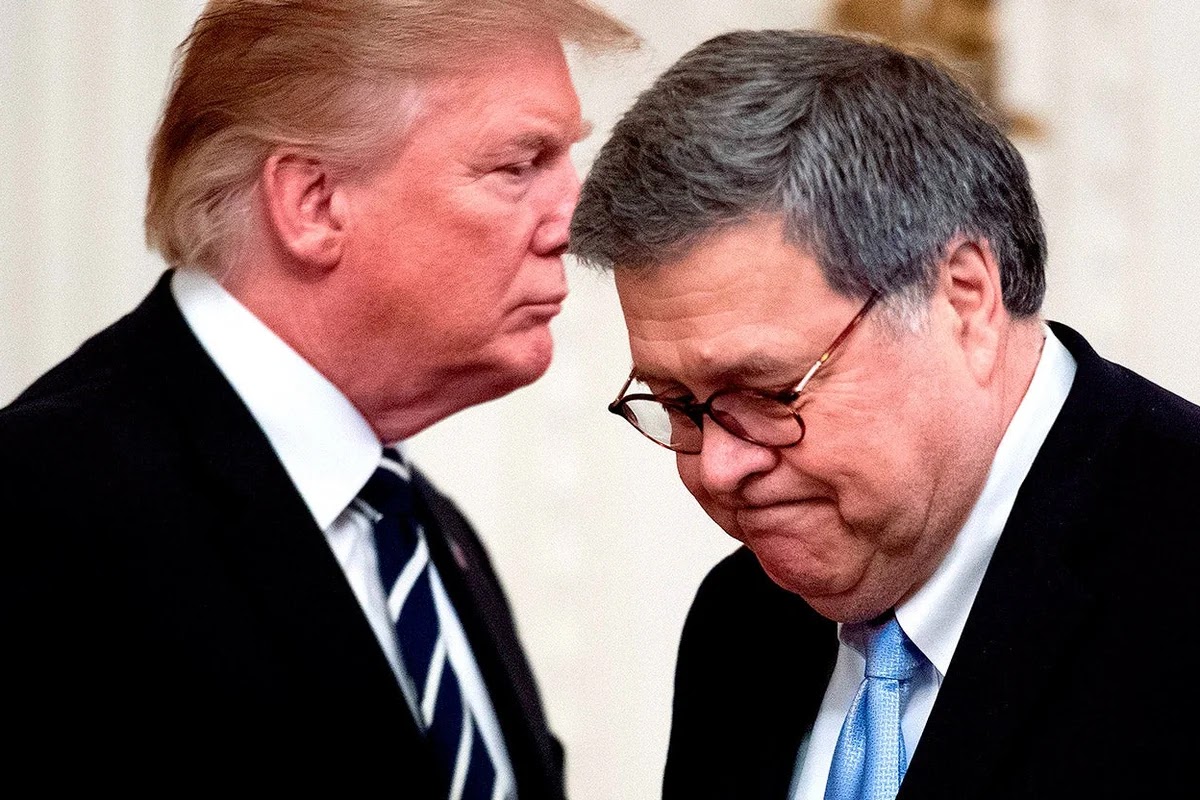
This is the question that pestered me all weekend. I just don't think you'd have to tweak Waldorf too hard to come up with William Barr, especially with the turned-down-mouth, lips-pulled-in expression of disgust that he's most commonly made during public appearances with Trump. His latest gig as surrogate for Merrick Garland on questions about the Mar-a-Lago raid raises the continuing question for me that he never took the position of Attorney General under Trump in good faith -- I suspect there was actually a back-channel deal among Barr, McConnell, Romney, and assorted other Senate RINOs to confirm him in 2019 on the basis that, like Jeff Sessions, he wouldn't actually implement Trump policies.

I would also go a little farther and suggest that Barr isn't so much an apologist for Garland as he is an apologist for the deep state. In fact, I would suggest that the example of Barr is a refutation of the notion that the deep state is some sort of conspiracy theory. Let's take this Wikipedia entry as an expression of that notion:

According to a discredited American political conspiracy theory promoted by Donald Trump and his supporters, the deep state is a clandestine network of actors in the federal government, high-level finance, and high-level industry operating as a hidden government that exercises power alongside or within the elected United States government.

Variations of the deep state have existed as popular conspiracy theories in the United States since the 1950s.

The deep state conspiracy theory reached mainstream recognition under the presidency of Donald Trump, who referenced the ‘deep state’ as working against his administration’s agenda.

Opinion polling done in 2017 and 2018 suggests that approximately half of all Americans believe in the existence of a deep state.

However, the idea of a "deep state" predates the 1950s and has never necessarily been a right-wing theory. Ferdinand Lundberg, a populist and by no means a right-winger, published America's 60 Families in 1937, which according to Wikipedia

is an argumentative analysis of wealth and class in the United States, and how they are leveraged for purposes of political and economic power, specifically by what the author contends is a "plutocratic circle" composed of a tightly interlinked group of 60 families.

Critics have pointed out that Lundberg never specifically identified those families, but Lundberg's hyperbolic style suggests he never intended to -- it was a metaphorical outline of how things worked. C Wright Mills's 1956 The Power Elite, according to Wikipedia,

calls attention to the interwoven interests of the leaders of the military, corporate, and political elements of society and suggests that the ordinary citizen in modern times is a relatively powerless subject of manipulation by those three entities.

. . . According to Mills, the eponymous "power elite" are those that occupy the dominant positions, in the three pillar institutions (state security, economic and political) of a dominant country. Their decisions (or lack thereof) have enormous consequences, not only for Americans but, "the underlying populations of the world." The institutions which they head, Mills posits, are a triumvirate of groups that have inherited or succeeded weaker predecessors:

Mills was hardly a conspiracy theorist in the shadows; he had a PhD from the University of Wisconsin and a full academic career with grants at the University of Maryland and Columbia University. Far from a right-winger, he was a Trotskyite. His books, while aimed largely at a popular audience, continue to be influential among academics.

Another popular writer of the 1950s and 60s was Vance Packard:

In The Hidden Persuaders, first published in 1957, Packard explored advertisers' use of consumer motivational research and other psychological techniques, including depth psychology and subliminal tactics, to manipulate expectations and induce desire for products, particularly in the American postwar era. He identified eight "compelling needs" that advertisers promise products will fulfill (Emotional Security, Reassurance of worth, Ego gratification, Creative outlets, Love objects, Sense of power, Roots, Immortality).

According to Packard, these needs are so strong that people are compelled to buy products merely to satisfy them. The book also explores the manipulative techniques of promoting politicians to the electorate. Additionally, the book questions the morality of using these techniques.

This might be looked on as a constellation of assertions by best-selling mainstream journalists and academics in the 1930s through 1950s that US society is dominated by wealthy elites with interlocking interests that use media and the political process to impose their consensus views on a largely powerless public.

I don't think you could find a better example to substantiate those views at the current moment than William Barr and his contentious relationship with Donald Trump, who has made a successful post-retirement career as an amateur politician who fronts for a working and middle class that's become aware that their interests don't necessarily conform to the elite consensus outlined by Lundberg, Mills, and Packard.

That Trump in many ways before retirement worked within that elite consensus as an entrepreneur and media figure gives credibility to his political persona -- but his political persona as an opponent of the elite consensus is his whole stock in trade. He is not a policy candidate, he's a personal champion.

This is the source of the current elite anger, and you couldn't ask for a better foil in the present news cycle than Barr, who's little more than a muppet.

Tuesday, September 6, 2022

Never Trump And The Special Master

As reported by CNN,

A federal judge threw a wrench Monday in the Justice Department investigation into potential mishandling of documents from former President Donald Trump's White House by granting his request for a special master to review evidence seized from his Florida home last month.

The win for Trump temporarily prevents the Justice Department's investigative team from accessing the thousands of documents -- some of which are marked as classified -- taken from Mar-a-Lago.

US District Judge Aileen Cannon cleared the way for a third-party attorney to review all the seized materials, not just for documents covered by attorney-client privilege -- the circumstance in which special masters are usually used -- but also for potential executive privilege concerns, a move the Justice Department has said would be "unprecedented."

Good news for Trump, right? Well, not so fast! Never Trumper Andrew McCarthy at the National Review manages not just a glass-half-empty take on the development, but more like a glass-not-there-at-all. McCarthy's NR piece is behind a paywall, but the rabidly never Trump Hot Air blog gives us a glimpse:

Trump dragged his feet in seeking the special master, to the point that DOJ had nearly completed its privilege review by the time he finally filed his court action. Cannon, whom Trump appointed to the district court in 2020, inexplicably allowed nine days to elapse after first signaling her inclination to appoint a special master, during which she wrung her hands about whether to order the appointment and, more significantly, failed to rule on Trump’s application for a court-ordered suspension of the Justice Department’s review process and directive that DOJ cease using documents Trump claimed were privileged in furtherance of its criminal investigation.

So, inexplicably, a bumbling, procrastinating Trump somehow convinces a dithering, oblivious, non-feasant judge to throw the Mar-a-Lago probe into chaos, which is bad news all around -- and I'm not sure if McCarthy has his facts right, because based on CNN's account, the ruling "temporarily prevents the Justice Department's investigative team from accessing the thousands of documents", which as far as I can tell means the DOJ must "cease using" those documents until a special master reviews them.

And CNN's metaphor of "threw a wrench" is actually milder than McCarthy's characterization that the judge threw the DOJ incvestigation "into chaos". Isn't it odd that such a preening, ineffectual, narcissistic rogue should somehow win a substantial victory in court? And the subtext from McCarthy and others like William Barr is that the DOJ investigation is fully justified and constitutional, and as McCarthy put it in the New York Post on August 31, there's a there there:

The court filing made by the Justice Department on Tuesday night, in response to Trump’s lawsuit seeking a special master to review materials seized by the FBI, indicates that prosecutors have amassed formidable evidence of obstruction. That’s a game-changer.

As I explained in The Post last week, "The Justice Department typically takes very seriously any tampering with witnesses or evidence." Moreover, if it turned out that the FBI had damning "proof of attempts to conceal or destroy government records, especially highly classified ones," that would amount to criminal conduct that is virtually always prosecuted.

But as far as anyone can surmise at this point, the basis for the Mar-a-Lago raid was that n boxes of random artifacts had been gathered up from the residential quarters by White House housekeeping staff in the final hours of Trump's term. These were sealed and moved to a locked storage room under video surveillance at Mar-a-Lago. From what has emerged in unsealed receipts, the artifacts consisted largely of old magazines and newspapers, among which documents that had been marked classified were sometimes interleaved, although their presence in the White House residence, from which they were taken by housekeepers, was fully authorized.

During subsequent negotiations, Trump returned roughly half of those boxes to the National Archives. There is no indication that he himself had any interest in what was in the boxes, undertook any personal review of their contents, or attempted to destroy anything that was in them. This is pure surmise by figures like McCarthy and Barr, driven by a strange and near obsessive animosity toward Trump.

I'm also puzzled at McCarthy's sudden impatience with the legal system. Trump "dragged his feet". (The raid took place August 8; Trump's petition for a special master was filed August 22, exactly two weeks.) The judge "allowed nine days to elapse". I've got to say that although I'm not an attorney, I've learned enough about the law that things often move slowly. Very slowly. Judges take weeks and months to issue rulings as a matter of course -- nine days is fast. McCarthy as a former US Attorney must recognize this at some level. The Mar-a-Lago raid was, after all, intended to come as an early-morning surprise for Trump, whom the prosecutors knew would be out of town. It took Trump exactly two weeks to assemble a legal team to respond and develop a strategy, which McCarthy himself says has now thrown the prosecutors' case into chaos.

I understand the never Trumpers' position less and less. The one observation that can be made of Trump as an amateur newcomer to this highest-stakes political game is that he's actually acquitted himself pretty well in it from the start. His handling of the Mar-a-Lago case reflects that, at least so far. The anger of the never-Trumpers reflects that as well, it seems to me.

Sunday, September 4, 2022

Trump Responds To Barr

When I posted on the unhappiest-looking guy in public life, William Barr, yesterday, I wasn't aware that Trump and his people would respond to Barr's Friday comments about the Mar-a-Lago raid. As it turns out, their response is remarkably substantive, and it actually throws the question back to Barr. (The photo above is from yesterday's story at the Epoch Times on the response; it was taken at the event on June 1, 2020 in which Trump and other officials walked from the White House to the burned-out St John's Episcopal Church across the park following a BLM riot. You can see how on board Barr was with the event, although in hindsight, the walk, simply displaying support for our institutions in the face of disorder, was entirely appropriate.)

The Epoch Times story notes,

“I can’t think of a legitimate reason why they could be taken out of the government, away from the government, if they’re classified,” [Barr, ] who was attorney general during the Trump and George H.W. Bush administrations, said during an appearance on Fox News.

“I frankly am skeptical of this claim that ‘I declassified everything,’ because, frankly, I think it’s highly improbable and second, if in fact, he stood over scores of boxes not really knowing what was in them, and said ‘I hereby declassify everything in here,’ that would be such an abuse, and show such recklessness that it’s almost worse than taking the documents.”

Trump publicly ordered in October 2020 the “total declassification” of “any and all documents” related to the U.S. investigation into alleged Russia-Trump collusion, as well as all documents related to the use of a private email server by former Secretary of State Hillary Clinton.

However, then-White House chief of staff Mark Meadows said in a sworn declaration filed in court shortly after that the order did not “require the declassification or release of any particular documents” and that Trump delegated the declassification to Barr, whose department ran the shoddy Russia-Trump investigation. The Department of Justice also said it was told as much by the White House. Trump recently pointed to a Jan. 19, 2021, memorandum he issued declassifying other documents.

In other words, it was onto Barr to declassify documents in response to Trump's specific order, and if in Barr's view they hadn't been, it was Barr's fault. It's worth noting that nobody yet knows exactly what the Justice Department was after in the Mar-a-Lago raid, but there has been speculation, founded among other things on leaks from intelligence officials, that the DOJ wanted Russiagate information. According to Newsweek on August 17,

The FBI raid on Mar-a-Lago last Monday was specifically intended to recover Donald Trump's personal "stash" of hidden documents, two high-level U.S. intelligence officials tell Newsweek.

To justify the unprecedented raid on a former president's residence and protect the source who revealed the existence of Trump's private hoard, agents went into Trump's residence on the pretext that they were seeking all government documents, says one official who has been involved in the investigation. But the true target was this private stash, which Justice Department officials feared Donald Trump might weaponize.

. . . The sought-after documents deal with a variety of intelligence matters of interest to the former president, the officials suggest—including material that Trump apparently thought would exonerate him of any claims of Russian collusion in 2016 or any other election-related charges.

When Trump left the White House in January 2021, many of the normal processes of transition were not followed, especially because the president would not admit that he had lost the election or that he would be leaving office. As a result, we now know, some 42 boxes of documents were shipped to Mar-a-Lago by mistake: officials papers under U.S. law, which the National Archives is supposed to take custody of and catalog.

However, the Presidential Records Act that gives the Archives authority over the documents is not a criminal statute, carries no penalties, and has not been enforced in similar disputes with other ex-presidents.

The question I raised in yesterday's post was how Barr, who has clear class interests with the established wealthy elites and the deep state, could have brought himself to serve as Trump's Attorney General. Trump's response as reported in the Epoch Times link is remarkably generous, all things considered:

Barr was known as a staunch Trump defender after becoming attorney general in 2019 but towards the end of the administration, he publicly diverged from Trump on a number of issues, including alleged election fraud.

In a statement on his Truth Social network after Barr’s comments, Trump said that the former attorney general is a Republican in name only, or a RINO, “who was so afraid of being Impeached that he became a captive to the Radical Left Democrats.”

“Barr never fought the way he should have for Election Integrity, and so much else. He started off OK as A.G., but faded fast—Didn’t have courage or stamina. People like that will never Make America Great Again!” Trump added.

Judging from Barr's facial expression in the June 2020 photo at the top of this post, he'd certainly faded by then. Actually, I doubt if he was ever on board, and I question his motives throughout. In saying Barr just ran out of stamina, Trump was being awfully nice.

Saturday, September 3, 2022

Why Is Everyone So Angry?

I was originally going to title this post, "Why Is William Barr So Angry?" but after Thursday's Dark Brandon speech, I realized everyone's angry, not just William Barr. Still, just before I changed my title, I was searching the web for images of an angry William Barr, and I discovered there are a lot of them. A lot of them. Barr is basically a professional angry guy. Let's look at his background. According to Wikipedia,

William Pelham Barr (born May 23, 1950) is an American attorney who served as the 77th and 85th United States attorney general in the administrations of Presidents George H. W. Bush and Donald Trump.

Born and raised in New York City, Barr was educated at the Horace Mann School, Columbia University, and George Washington University Law School. From 1971 to 1977, Barr was employed by the Central Intelligence Agency. He then served as a law clerk to judge Malcolm Richard Wilkey of the United States Court of Appeals for the District of Columbia Circuit. . . . . Before becoming attorney general in 1991, Barr held numerous other posts within the Department of Justice, including leading the Office of Legal Counsel (OLC) and serving as deputy attorney general. From 1994 to 2008, Barr did corporate legal work for GTE and its successor company Verizon Communications, which made him a multimillionaire. From 2009 to 2018, Barr served on the board of directors for Time Warner.

Barr is a longtime proponent of the unitary executive theory of nearly unfettered presidential authority over the executive branch of the U.S. government. . . . An influential advocate for tougher criminal justice policies, . . . Under Barr's advice, President George H. W. Bush in 1992 pardoned six officials involved in the Iran–Contra affair.

So wait a moment. Up to some point, Barr was "a longtime proponent of the unitary executive theory of nearly unfettered presidential authority". Shouldn't that have been good for, er, President Trump? Apparently not. Over the past week, he's become one of the angriest of the angry never-Trump talking heads:

Former Trump Attorney General Bill Barr said Friday on FNC’s “America Reports” that it is “unprecedented” that former President Donald Trump had classified material at his Florida estate and he “jerked around” the Department of Justice for a year while they tried to recover the documents.

. . . He added, “Now, let me just say, I think the driver on this from the beginning was, you know, loads of classified information sitting in Mar-a-Lago. People say this was unprecedented, but it’s also unprecedented for a president to take all this classified information and put him in a country club. And how long is the government going to try to get that back? You know, they jawboned for a year. They were deceived on the voluntary actions taken. They then went and got a subpoena. They were deceived on that. They feel and the record, the facts are starting to show that they were being jerked around. And so how long, you know, how long do they wait?”

So Barr was tough on crime, but it appears that the crime he's toughest on these days is that committed by Donald Trump, who constructively possessed documents that were declassified the instant he took them from the Oval Office to the White House residence but were inadvertently packed up by the housekeepers and sent to Mar-a-Lago the day he left office. Trump's attorneys compare this to having overdue library books, which may be hyperbole, but it strikes me as a better characterization than jerking the whole Justice Department around -- which I don't believe is actually a violation of federal law in any case.

But I think there are explanations for this in Barr's background. Remember that one of the best class markers that observers of the US elites note is actually not an Ivy degree -- though Barr is a Columbia alum -- but attendance at an exclusive prep school -- Barr's is Horace Mann. And then he went to the CIA right after law school -- the CIA is another class marker, like it or not; William Buckley had a similar career path after Yale. But let's look at Barr's father, Donald Barr:

Donald Barr (August 8, 1921 – February 5, 2004) was an American educator, writer, and Office of Strategic Services (OSS) officer. He was an administrator at Columbia University before serving as headmaster at the Dalton School in New York City and the Hackley School in Tarrytown, New York. . . . His sons are former United States Attorney General William Barr and physicist Stephen Barr.

. . . He was headmaster of the Dalton School from 1964 to 1974. During his time as Dalton's headmaster, Barr is alleged to have had a role in hiring future financier and convicted sex offender Jeffrey Epstein as a math teacher despite the fact that Epstein (who graduated from high school at the age of 16 and secured a full scholarship to Cooper Union) had failed to complete his degree and was only 21 years old at the time.

These are fascinating data points. The OSS, known at the time as "oh-so-social", was even more of a class indicator than the later CIA, and it's worth noting that the populist-leaning Harry Truman hated its director, "Wild Bill" Donovan (Columbia 1905), and ardently opposed establishment of its successor, the CIA. (It appears the lizard people won that particular round.) Donald Barr was a Columbia alum (1941) at a time when, before the introduction of SAT tests, the Ivies were not selective, and an Ivy degree was much more reliably a class indicator. (We may also assume that, like it or not, his son William was a legacy.)

That Donald should go on to make a career of headmasterships at elite prep schools is another class indicator, but that he should be among Jeffrey Epstein's earliest dupes also suggests he was largely an empty suit who relied on his contacts and his background to place him in prestigious but largely unproductive jobs.

But this is the environment that produced William Barr. That my Dad's backgound should give me a leg up in society, in the legal world, in corporate directorships, and in government, making me rich in the process, ought to make me a happy guy. Why is this man not smiling? Based on all the images I find on the web, William P Barr has got to be one of the saddest, angriest men in current public life. Is it because so many crooks are still out of jail? Is it because presidential authority remains insufficiently unfettered? The man is rich. He's respected. He's in demand as a talking head. No doubt his mere stroke of the pen will get any candidate into Dalton, Horace Mann, Hackley, whichever, not to mention Columbia.

But he's sad and angry. I think it's because of Trump. I think it's because Trump hasn't gone away. And Trump is a Republican, doggone it. Trump is the wrong kind of Republican, not like, say, Jeb Bush. And that has him awfully, awfully angry. Why did he ever agree to become Trump's attorney general? That's a good question, wouldn't you say?

Friday, September 2, 2022

Not That Difficult

Here's Biden's problem, and I think it's clear enough that even he recognizes it. The slimmest of Democrat majorities in Congress have shielded him from investigations over the past two years. If he loses either house in the November elections, Republicans will control key oversight committees with subpoena power, which will at best threaten his prospects in 2024 -- but there are potential avenues of investigation that could reach a "Nixon standard". This phrase has come up in connection with potential Trump offenses that could have been uncovered in the Mar-a-Lago raid (but so far have not) -- but I'm not the only one who's seen parallels between Nixon and Biden as well.

A quick web search suggests that there's never been a clear definition of a "Nixon standard" for impeachment, but of course, Nixon was never impeached, so his case can't be a precedent anyhow. Nevertheless, legal scholars in the Clinton impeachment came up with this definition as it was developed by congressional staff in the Nixon investigation:

Impeachment is a constitutional remedy addressed to serious offenses against the system of government. . . . It is not controlling whether treason and bribery are criminal. More important, they are constitutional wrongs that subvert the structure of government, or undermine the integrity of office and even the Constitution itself, and thus are `high' offenses in the sense that word was used in English impeachments.

The "smoking gun" allegation against Nixon involved his attempt to use the CIA to convince the FBI not to investigate the Watergate burglary:

A secretly recorded conversation between President Richard Nixon and his aide H.R. Haldeman on June 23, 1972, reveals the president's involvement in the Watergate break-ins and cover-up. During the conversation, which became known as the "Smoking Gun," Nixon and Haldeman discuss telling Deputy CIA Director Vernon Walters to interfere with FBI Acting Director Pat Gray's investigation.

There was never a House vote to impeach Nixon on this allegation, and never a Senate trial, but the evidence was felt at the time by senior Republicans to be sufficient that they should urge him to resign in the face of likely impeachment and conviction, which he did.

Right now, there are two potential avenues of investigation that could reach this "Nixon standard". The first would be if it were provable that Biden ordered an investigation, including a raid on Mar-a-Lago, that would lead to an indictment of Trump on nearly any grounds short of deliberately passing secret information to Putin for the purpose of undermining the US. This is highly unlikely, and an indictment short of that would be an extreme gamble for Biden that would likely fail.

The second, which has developed more recently, is any Biden involvement in using the government to pressure private media to censor COVID information:

[N]ew evidence suggests a much wider campaign by his administration to sic Big Tech on critics than previously thought, going so far as removing a parody of Biden's chief medical adviser Anthony Fauci.

The First Amendment lawsuit by Republican attorneys general and a civil liberties group against Biden, Fauci and several other high-level officials has revealed a "massive, sprawling federal 'Censorship Enterprise'" related to COVID-19 and elections, the plaintiffs said in a 711-page "joint statement on discovery disputes."

"If there was ever any doubt the federal government was behind censorship of Americans who dared to dissent from official Covid messaging, that doubt has been erased" by what the defendants have already turned over, New Civil Liberties Alliance lawyer Jenin Younes said.

A third potential issue might be an "Agnew standard":

Agnew’s downfall began in the summer of 1973, when he was investigated in connection with accusations of extortion, bribery, and income-tax violations relating chiefly to his tenure as governor of Maryland. Faced with federal indictments, Agnew fought the charges, arguing that the allegations were false, that a sitting vice president could not be indicted, and that the only way he could be removed from office was by impeachment. . . . secret plea bargaining took place between Agnew’s lawyers and a federal judge. Agnew resigned the vice presidency on October 10, 1973, and appeared in United States District Court in Baltimore on the same day to plead nolo contendere to a single federal count of failing to report on his income-tax return $29,500 in income that he had received in 1967, while governor of Maryland. Acknowledging that the plea amounted to a felony conviction, Agnew declared that he had resigned in the national interest. He was fined $10,000 and sentenced to three years of unsupervised probation.

In Biden's case, there's the potential for equivalent tax violations in the numerous questionable business deals engineered by his son Hunter. A forced resignation on this basis would be pretextual, but if Republicans are able to get a special prosecutor appointed for Hunter's transactions, this would be another potential outcome for Biden.

I'm occasionally beginning to see remarks that Biden is already running against Trump for 2024, but what I think is really happening is Biden sees threats to his tenure before then if Republicans gain control of either house in 2022.

But the national mood is changing as well. Media across the spectrum is less of a monolith, with CNN moving to the center, the intramural dispute over Live PD, and of all things the departure of extreme never-Trumper Allahpundit from the never Trump Hot Air blog as of today, which I suspect is further fallout from Liz Cheney's electoral defeat.

And Trump is still a contender, with Biden's current effort against him having the counterproductive effect of putting him in the national spotlight. He's already testing a 2024 platform of pardoning the January 6 defendants with an apology.

Thursday, September 1, 2022

The Dumpster Fire That Won't Go Out

Just the other day I had a post on the revival of the former A&E Live PD show, now on a new channel, Reelz, as On Patrol: Live. Just a day later, it was an item on regular news:

A&E filed a lawsuit seeking to block rival network Reelz from airing “On Patrol: Live,” which it claims is a blatant ripoff of its own show, “Live PD.”

Both shows feature live footage from police ride-alongs, both are hosted by Dan Abrams, and both are produced by the same company.

A&E canceled “Live PD” — one of its top-rated shows — in June 2020, at the height of protests over the murder of George Floyd in Minneapolis.

Reelz debuted its version of the show last month. In the lawsuit, A&E argues that “On Patrol: Live” copies nearly every aspect of its own show’s format, down to specific catchphrases. The Reelz show even occupies “Live PD’s” old time slot.

My wife and I resumed watching whatever you want to call the show as soon as we heard about it. The accounts are completely correct, the show is a full revival of Live PD down to the look and feel of the studio, just under a different name. There's no question that the show's audience, which was the biggest on weekend cable and among the biggest at any time, felt its cancellation at the peak of the cancel culture during the BLM riots of 2020 had been a grave error and was grateful for its return.

REELZ reeled in 3.5 million unique viewers for “On Patrol: Live,” with an average viewing time of 146 minutes across the seven telecasts over the premiere weekend starting July 22. The show made REELZ the second most watched network among all ad-supported broadcast and cable networks during its live showings on Friday and Saturday night, propelling REELZ into a top 25 cable network position for the first time ever. In Live+3 data, Friday’s episode grew 27% in HHs, from 623,000 to 792,000, and Saturday’s rose 22%, from 684,000 to 835,000.

In contrast,

A&E lost a ton of its “live” (plus same day) viewership after cancelling “Live P.D.” last year amid a firestorm over onscreen depictions of policing following the killing of George Floyd. Immediately after the network canceled “Live P.D.,” the cable channel’s primetime viewership declined 49% — or pretty much by half. That’s no surprise since at the time of its cancellation, “Live P.D.” was A&E’s highest-rated program and occupied multiple evenings on the schedule. Since then, things have been a bit better — but barely. For the recently ended second quarter of 2021, A&E was down 42% in total viewers from the same time in 2020, averaging 495,000 overall primetime audience members compared to 852,000 the year before. Those numbers, like all in this story, are according to Nielsen’s Live + Same Day data, which we chose due to the dominant live viewership delivered by live show “Live P.D.” But the loss of that block of reality programming has delivered a big hit. The month before “Live PD” was canceled, May 2020, A&E ranked as the No. 8 ad-supported cable channel in total viewers. The month after cancellation, A&E sunk all the way to 20th.

The show's host and de facto spokesman, Dan Abrams, had telegraphed throughout the summer of 2020 that efforts of some sort were under way to bring the show back at A&E, but they never came to fruition. At the time, A&E said in a blandly corporatese announcement,

"This is a critical time in our nation's history and we have made the decision to cease production on Live PD," A&E said in a statement. "Going forward, we will determine if there is a clear pathway to tell the stories of both the community and the police officers whose role it is to serve them. And with that, we will be meeting with community and civil rights leaders as well as police departments."

Wikipedia describes Dan Abrams as

an American media entrepreneur, television host, legal commentator, and author. He is currently the host of the prime-time show Dan Abrams Live on NewsNation, On Patrol: Live on Reelz and The Dan Abrams Show: Where Politics Meets The Law on SiriusXM's P.O.T.U.S. channel. He is also the Chief Legal Analyst of ABC News.

In other words, the man is a media heavyweight. I've had a mild interest in his career over the years, and as far as I've been able to tell, his opinions on social and political issues are fully consistent with every other media heavyweight at his level. In other words, he really isn't that much of a pro-cop sort of guy. On the other hand, Live PD or OP: Live, whichever you want to call it, is a gold mine, and Abrams is not opposed in principle to making a buck.

This brings up the actual conflict at the lizard-people level. With the 2020 COVID-and-BLM dumpster fire gradually receding in the rear view mirror, people who actually want to make money out of quality entertainment saw a chance to bring back Live PD, which had been canceled, apparently with no serious intention of ever reviving it, by A&E. Even in 2020, media analysts were questioning A&E's judgment, and two years later, A&E hasn't won back the nearly 50% of its audience it lost.

On one hand, the immediate popularity of the revival -- and its ability to return without renewed demands for its cancellation -- seem to have caught A&E flat-footed, with Reelz's sudden rise to prominence an additional embarrassment. At some point, someone is going to have to hold the suits at A&E responsible for, first, the original call of canceling the show, and then for doubling down on the original bad call.

However, the financial penalty to A&E is still probably just secondary to the main issue, that A&E seems to see itself as a cultural leader and thus with the authority to decide who gets to see what, on its own network or for that matter anywhere else. On one hand, they made a lot of money from a show the deplorables loved. On the other hand, once it became clear that the right people didn't want the deplorables watching it, A&E got with the program, and as far as they're concerned, the program is still the program. Money has nothing to do with it.

I think this is the actual conflict. Dan Abrams is on the side of the money. My guess is he's going to win. Dumpster fires are fun, but they eventually get old, especially when they cost money.