Sunday, October 23, 2022

The War Is Going To Widen
Via CBS News:

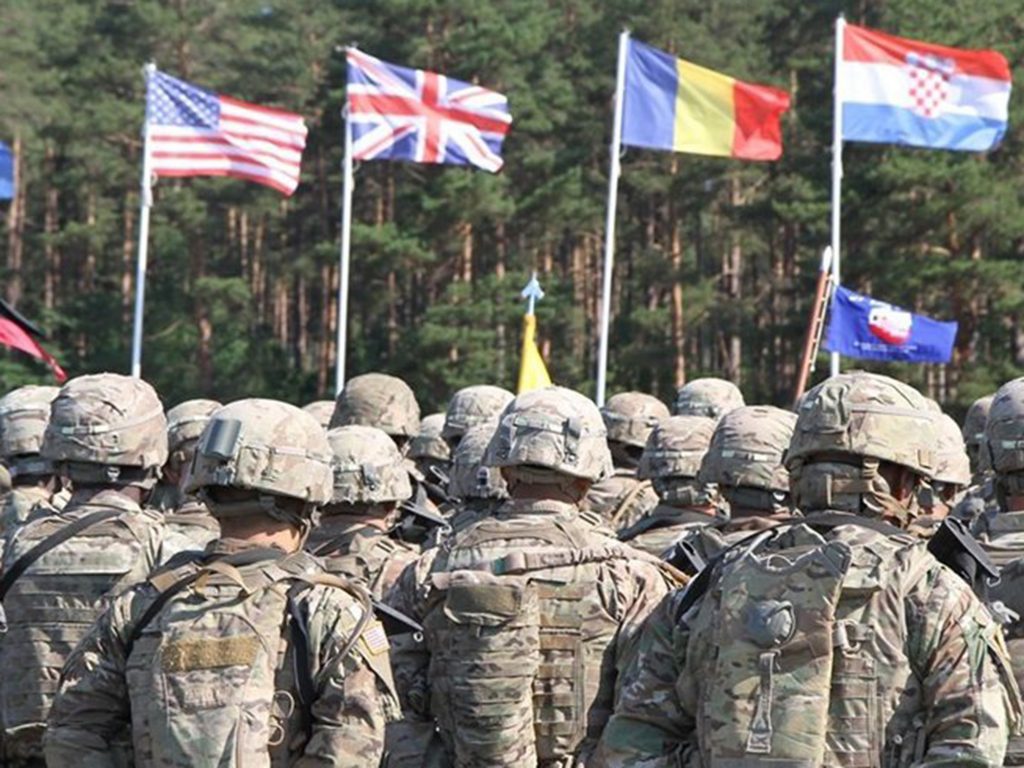
The U.S. Army's 101st Airborne Division has been deployed to Europe for the first time in almost 80 years amid soaring tension between Russia and the American-led NATO military alliance. The light infantry unit, nicknamed the "Screaming Eagles," is trained to deploy on any battlefield in the world within hours, ready to fight.

CBS News joined the division's Deputy Commander, Brigadier General John Lubas, and Colonel Edwin Matthaidess, Commander of the 2nd Brigade Combat Team, on a Black Hawk helicopter for the hour-long ride to the very edge of NATO territory — only around three miles from Romania's border with Ukraine.

. . . Skirting northward along Romania's Black Sea coast, the Black Hawk eventually touched down at a forward operating site where U.S. and Romanian troops were pounding targets during a joint ground and air assault exercise.

The tank rounds and artillery fire were real. The drill was meant to recreate the battles Ukraine's forces are fighting every day against Russian troops, just across the border. The war games so close to that border are a clear message to Russia and to America's NATO allies, that the U.S. Army is here.

We may assume that with the CBS reporters riding a helicopter with a general, the visit and even the precise wording of the report were fully approved by the Pentagon, and by extension both Secretaries Austin and Blinken. The president was in Delaware.

Meanwhile, from Gen Petraeus, who seems to be the unofficial spokesman for what has been communicated to Putin via channels, we hear:

The last we heard from Petraeus in this vein, it was to imply that the use of nukes in Ukraine would bring a strong US reaction, and this had been communicated to Putin. Opinion now seems to be that with Russia potentially planning to blow the Nova Kakhova dam as part of its retreat from western Kherson, the resulting flooding would represent a humanitarian disaster worse than a nuke, and by the way a war crime.

It appears that Western elites are more and more uncomfortable with ongoing Russian war crimes in Ukraine, which would include the civilian suffering resulting from destruction of the Ukrainian power grid during autumn and winter. There have been interesting comments on the reddit thread reacting to Petraeus's statement:

NATO intervened in Bosnia and Kosovo. It stopped the wars and forced a peace partly because of the unatable security situation caused in Europe. I think NATO has grounds to do intervene in meaningful way as it could be in the collective best interests of North Atlantic countries. In terms of peace, economics, and regional stability.

. . . Nevertheless, presuming what you are saying is "let's not use that as an excuse to not engage", I'd also like to see NATO members (if not the organization itself) with boots on the ground on a volunteer basis.

Even better would be recent NATO intervention performed at the behest or with the approval of the Security Council such as has happened several times in recent history. But clearly that's not going to happen with Russia in the council.

The question I've had from the start, and I've been raising it here, is that any conceivable end state for the war is going to require international enforcement. Even if Ukraine is able to push Russia back to the pre-2014 borders using only current levels of Western aid, that won't solve anything -- Putinist Russia will simply rearm and stage continuing provocations indefinitely, resulting in an even less tenable situation in Europe than was caused by Bosnia and Kosovo.

I've got to assume the lizard people have figured this out and will move to restore stability sooner rather than later. In fact, I think they've even figured it out by now that a "negotiated settlement" that simply restores a status quo ante February 24 won't work, either. One way or another, NATO will be directly involved. There's going to be a need to get this fixed.

Saturday, October 22, 2022

Yeah, He's Already Been Told

When I think back on my corporate career, I remember case after case where the Senior VP, or whatever the big boss's title was, had been told he was no longer needed. At that level, they were never escorted out the door, but it was plain they had only weeks remaining. Still, they were allowed to keep up appearances until the end. But you could read the signs. They didn't show up at the planning meeting for next fiscal year, for instance.

Rhetorically, President Brandon's remarks in the interview linked above give the game away: "It's my intention to run again." Not "Don't be silly, of course!" Instead, after a peculiarly worded question, "Dr. Biden is for it?", silence.

"Dr Biden" had nothing to do with the decision. I'm not sure how it was delivered. My estimate is that Secretary Blinken is the highest-ranking, if not the only, lizard person in the administration, and as I've said, I think he has status comparable to Averell Harriman or Nelson Rockefeller. I also think he's fed up with Joe Brandon, who's proven incapable of speaking from his assigned script, to the point where in the current diplomatic environment he's dangerous.

I would theorize that the decision was conveyed via Mr Klain in impersonal, passive-voice terms, it was delivered recently, and it's final. It's looking like the November elections are going to be worse for Democrats tjhan anyone predicted, and with Republicans in committee roles, Hunter will be a focus. The only way to salvage 2024 will be to remove Brandon as a target. Lame duck status also distances the US from future ill-considered remarks that might otherwise be provocative.

In fact, he did the job he was hired for, which was to get rid of Trump in 2020. The whole Democrat strategy was Götterdämmerung, if the world is about to end, then let's run up the credit cards and enjoy ourselves while we can. But the world didn't end after all, the bills still have to be paid, and they didn't even get rid of Trump.

The awkard silence in the interview came as the big guy relived the moment he was told he wasn't running. He didn't even have the chance to invoke Dr Jill.

Friday, October 21, 2022

The Thing About Zelensky

As I suggested yesterday, the world globalist consensus doesn't know quite what to do with President Zelensky. Leading up to February 24, the conventional wisdom across the board was that Russia would reach Kyiv within days, and the humane option was to offer Zelensky and his circle rides out on C-130s. When he refused to do this, it took policymakers by surprise and created an instant bien pensant consensus in favor of Ukraine, without a whole lot of reflection on what this might imply. Witness just this tweet from last night: But wait, up to late February, American foreign policy was to offer Zelensky a ride out, wasn't it?

The Associated Press reported that Ukrainian President Volodymyr Zelenskyy rejected an offer to be evacuated from the U.S. government. Zelenskyy's reply, according to a senior American intelligence official: "The fight is here; I need ammunition, not a ride."

At least, we may infer that a ride was what the US officially offered, and a "senior intelligence official" was aware of the reply. I would say that this almost immediately put the US foreign policy establishment in a bind -- in the wake of the disaster in Kabul, they couldn't risk a repeat, at least not so soon. This was the start of a pattern whereby Zelensky could use his charisma and his underdog status to force policy decisions on Western politicians that they were in fact reluctant to make. Months later, the US president has done an effective 180, accusing Republicans of not being with the program:

It's a lot bigger than Ukraine. It's Eastern Europe. It's NATO. It's real serious, serious consequential outcomes. They have no sense of American foreign policy.

But this isn't the only area where Zelensky has been forcing changes. Consider dcevelopments over Iran's new involvement in the Ukraine war vis-s-vis former US Iran policy:

During his initial presidential campaign in 2007-08, Barack Obama repeatedly declared his intention to improve US-Iran relations, and he followed through after taking office. However, President Obama took a different approach than his predecessors. Previous US-Iran engagements maintained the US-stated intention of changing the nature of the Islamic regime in Iran, seeking global improvement on a host of issues, and kept the threat of military force ever-present. . . . Obama sought to assure not only the Iranian people but also its leadership that Washington’s intention was not to alter the nature of the Islamic Republic, but to engage the leadership in Tehran through dialogue and multilateralism. He narrowed the topic to encouraging a behavioral change on the specific issue of nuclear fuel enrichment. The US president’s policy approach to Iran’s nuclear question is the best-applied example of what is now known as the Obama Doctrine.

In 2018, Trump backed out of the Obama nuclear deal, but Biden's somewhat vague intent has been

to get Iran to return to compliance with the technical nuclear aspects of the agreement. The second is to commence additional negotiations on three areas beyond the JCPOA: Iran’s ballistic-missile development, its malign activities in the region, and extending timelines on some aspects of its civil nuclear activities.

But now the US is officially acknowkedging that Iran is directly supporting the Russian side in the Ukraine war:

The White House confirmed on October 20 that Iranian military personnel are in Russian-occupied Crimea, Ukraine, to assist Russian forces in conducting drone attacks on Ukrainian civilians and civilian infrastructure. US National Security Council Spokesperson John Kirby told reporters that “a relatively small number” of Iranian personnel are in Crimea to train Russian personnel in the use of unfamiliar Iranian-made drones. Kirby emphasized that “Tehran is now directly engaged on the ground and through the provision of weapons that are impacting civilians and civilian infrastructure in Ukraine, that are killing civilians and destroying civilian infrastructure in Ukraine” and warned that Russia and Iran will continue to lie about their partnership.

At minimum, this makes the Biden foreign policy prospect of a grand deal on the Middle East brokered with the concurrence of Iran even more remote, but with the radical shift in the balance of power illustrated by the Russian collapse in Ukraine, if Iran comes in on the Russian side, this also lowers its world standing. From the Jerusalem Post:

Iran’s increasing role in backing Russia has increased awareness of Iranian threats. This illustrates that although the Islamic Republic was involved in human-rights abuses in Iraq and Syria, backing Hamas, the Houthis and Hezbollah, and carrying out attacks all over the Middle East, threatening the UAE, Saudi Arabia, Iraq, Syria, Lebanon, Israel, US forces, Turkish forces in Iraq and others, it is Iran’s role in helping Russia that has tipped the scales against itself.

. . . Iran’s crackdown on protests and its decision to grow closer to Russia, at a time when the West is angered by Russia’s invasion of Ukraine, appears to be a final straw regarding any appeasement of Tehran. Now, it is clear that Iran’s threats won’t remain in the Middle East and that working with it hasn’t helped. Instead, it empowered Tehran to work with Moscow, which is using Iranian-style weapons to kill civilians in Ukraine.

These developments can all be traced back to Zelensky and his leadership in the war. He's actually had wide-ranging impact on global policy, and I have an inkling that most globalists haven't been very comfortable with him. He's an extremely skilled actor with Ukraine's interests primarily, if not exclusively, in mind, and where these conflict with globalist interests, he won't hesitate to resist, which he's shown he can effectively do.

Thursday, October 20, 2022

The Lizard People Aren't Happy About Ukraine, And They Think It's Biden's Fault

I've seen some intriguing data points over the past day that are giving me some ideas about what the people who really run the show are thinking. First, the US State Department, Antony Blinken (net worth $65 million, although the Blinken family controls far more), Secretary, has had to spank President Brandon yet again for un-vetted remarks:

Biden made the offending comments at a Democrat Party event at a private home in California last week.

Offering disorganized remarks commenting on nuclear weapons generally, Biden mentioned Pakistan amid boasting yet again that he has a close personal relationship with dictator Xi Jinping of China.

. . . “This is a guy [Xi] who understands what he wants but has an enormous, enormous array of problems. How do we handle that?” the president asked. “How do we handle that relative to what’s going on in Russia? And what I think is maybe one of the most dangerous nations in the world: Pakistan. Nuclear weapons without any cohesion.”

. . . Following the publication of the event’s official transcript, Pakistan’s Foreign Affairs Ministry immediately summoned the U.S. Ambassador to Islamabad Donal Blome and requested the ambassador deliver a demarche on President Biden’s comments.

. . . Principal Deputy Spokesperson of the U.S. Department of State Vendal Patel addressed the growing scandal on Tuesday, telling reporters, “the United States is confident of Pakistan’s commitment and its ability to secure nuclear assets.”

The problem with weird Uncle Joe is that not only does he fondle nymphets and sniff their hair at whim, but he runs his mouth uncontrollably, and this is starting to look dangerous:

President Joe Biden and Russia’s Vladimir Putin are slated to attend next month’s G-20 summit in Indonesia, setting up the possibility of a high-stakes face off in the midst of an increasingly deadly Moscow invasion of Ukraine.

U.S. officials are taking steps to ensure that doesn’t happen.

The story delicately skirts the question of how the anonymous "US officials" feel about the potential for spontaneous gaffes from the big guy that could lead the already unpredictable Putin to escalate, but the problem must certainly be behind their maneuvers.

It can’t be ruled out that Biden and Putin might cross paths at some point during the November summit, according to officials who note that the two men may, at some point, attend the same large plenary gathering. But U.S. officials have ruled out a formal meeting and are taking steps to ensure that the American president does not encounter his Russian counterpart in a hallway or even in a leaders’ group photo.

I'll grant that some Harvard alums do show prudence and common sense. After two years, they've got Biden's measure, and they've remembered Stein's Law: that which cannot continue must stop. Other indications show behind-the-scenes discomfort with how difficult it is to control his runaweay mouth. This story quotes the New York Times behind a paywall:

After Mr. Biden delivered a nearly two-hour news conference in January, members of his senior staff were rehashing the appearance in the Treaty Room when the first lady appeared.

She pointedly asked the group, which included the president, why nobody stepped in to stop it, according to a person who was in the room. Where was the person, she demanded, who was supposed to end the news conference?

The story goes on,

As the New York Post observed, that was the infamous [January 20, 2022] presser where Joe Biden greatly alarmed Ukraine by appearing to greenlight a “minor incursion” into the country by Russia, the latter of which was already sending strong signals that they would do much more than that. His handlers had to step in on to rescue Joe on that statement, too.

. . . It’s no wonder there are reports swirling of “contingency plans” being put in place by Democrats ahead of 2024. Joe Biden is a man who is simply not in control much anymore in any meaningful way, not in what he says nor in the way he behaves around others, all of which again raises the question as to just who or what group of people are actually taking the lead in the absence of his failures to do so?

The Lizard People are not happy about Ukraine. The hard-core globalists don't like the unpredictability -- the post-World War II balance of power has completely disappeared, while what the world will look like going forward isn't clear at all. The war itrself is a distraction, forcing choices over matters like green energy that the globalists don't want on the agenda. Beyond that, it's brought forward a charismatic and unpredictable leader in President Zelensky who is effectively forcing an independent diplomatic and military agenda on NATO and the EU. At the same time, feckless and colorless Western leadership in figures like Biden and Liz Truss damages the existing consensus.

I think if you were to press the globalists, they wouldn't be that far from the US Right in opposing Western aid to Ukraine. But with the damage done, they'll likely be insistent on seeing the Russians ejected quickly and some form of new, if temporary and inadequate, order imposed.

And it's not hard to trace responsibility for the Ukraine problem ito Biden's disastrous retreat from Afghanistan and smaller issues like his "minor incursion" remarks. As I've said before, Antony Blinken is a member of the power elite comparable to Averell Harriman and Nelson Rockefeller in a prior generation. I think the lizard people have made up their minds; they may even be forced to back a Republican in 2024. At least, a Republican of the right sort.

Wednesday, October 19, 2022

How Francis Fukuyama Helped Me To Understand The Force

I had one of those nights last night when I woke up with the feeling I hadn't fully figured something out. It clearly stemmed from Francis Fukuyama's Atlantic essay that I linked yesterday. I would summarize it via the following excerpts. First,

[Russia and China] were the vanguard of a broader authoritarian wave that turned back democratic gains across the globe, from Myanmar to Tunisia to Hungary to El Salvador.

But we mustn't lose heart. Indeed,

The long-term progress of modern institutions is neither linear nor automatic. Over the years, we have seen huge setbacks to the progress of liberal and democratic institutions, with the rise of fascism and communism in the 1930s, or the military coups and oil crises of the 1960s and ’70s. And yet, liberal democracy has endured and come back repeatedly, because the alternatives are so bad. . . . When I wrote an article in 1989 and a book in 1992 with ["the end of history"] in the title, I noted that the Marxist version was clearly wrong and that there didn’t seem to be a higher alternative to liberal democracy. We’ve seen frightening reversals to the progress of liberal democracy over the past 15 years, but setbacks do not mean that the underlying narrative is wrong. None of the proffered alternatives look like they’re doing any better.

So we get to the first inklings of a puzzle: authoritarian systems seem to have gained ground, and progress is neither linear nor automatic, but there's an "underlying narrative". Isn't that peculiar? We have an educated consensus that the world is essentially random (for example, in Darwinian theory), but there's nevertheless an "underlying narrative" that resulted in homo sapiens and eventually his Whig institutions, sort of. Don't ask me to explain, but Mr Fukuyama has apparently signed on to this. And he cites Hegel as his authority, which is important.

This is simply because Hegel has an "underlying narrative" that's generally consistent with 19th-century bourgeois secular optimism, and Hegelian dialectic is at the root of Fukuyama's confusion. I went looking for an explanation of Hegelian dialectic and found this in the Stanford Encyclopedia of Philosophy:

“Dialectics” is a term used to describe a method of philosophical argument that involves some sort of contradictory process between opposing sides. In what is perhaps the most classic version of “dialectics”, the ancient Greek philosopher, Plato. . . . [t]he back-and-forth dialectic between Socrates and his interlocutors thus becomes Plato’s way of arguing against the earlier, less sophisticated views or positions and for the more sophisticated ones later.

Whereas Plato’s “opposing sides” were people (Socrates and his interlocutors), however, what the “opposing sides” are in Hegel’s work depends on the subject matter he discusses.

. . . Note that, although Hegel acknowledged that his dialectical method was part of a philosophical tradition stretching back to Plato, he criticized Plato’s version of dialectics. He argued that Plato’s dialectics deals only with limited philosophical claims and is unable to get beyond skepticism or nothingness. . . . Hegel argues that, because Plato’s dialectics cannot get beyond arbitrariness and skepticism, it generates only approximate truths, and falls short of being a genuine science.

. . . Dialectics drives to the “Absolute”, to use Hegel’s term, which is the last, final, and completely all-encompassing or unconditioned concept or form in the relevant subject matter under discussion (logic, phenomenology, ethics/politics and so on).

So where Plato via Socrates will go only so far as to say, "this is absurd, it's a contradiction, we can't go there", Hegel says yes, we certainly can, because something new, inexorable, and absolute will arise from this contradiction. For Fukuyama, this is Whig History, "the rise of constitutional government, personal freedoms and scientific progress" as a teleological process, the "underlying narrative".

The problem for Fukuyama throughout the essay is that there are too many real-world obstacles to his Whig underlying narrative -- and of these, the greatest is Donald Trump, of all people.

Celebrations of the rise of strong states and the decline of liberal democracy are thus very premature. Liberal democracy, precisely because it distributes power and relies on consent of the governed, is in much better shape globally than many people think. Despite recent gains by populist parties in Sweden and Italy, most countries in Europe still enjoy a strong degree of social consensus.

The big question mark remains, unfortunately, the United States. Some 30 to 35 percent of its voters continue to believe the false narrative that the 2020 presidential election was stolen, and the Republican Party has been taken over by Donald Trump’s MAGA followers, who are doing their best to put election deniers in positions of power around the country. This group does not represent a majority of the country but is likely to regain control of at least the House of Representatives this November, and possibly the presidency in 2024.

Here's where I would raise my hand in the question period. "Mr Fukuyama, on one hand, you cite Hegel, who argues that the process of dialectics works of necessity to drive us to the absolute and unconditioned form of ethics/politics. Yet at the same time you see a need to struggle, as though this were a matter under question, and we in the US must struggle against Trump just as Ukraine struggles against Putin. But if there's an underlying narrative that the Whigs will prevail, why should we go to all this effort?"

And I could finally go back to sleep when I realized that Mr Fukuyama's answer would be, "Trust the Force, Luke!"

May the Force be with you all.

Tuesday, October 18, 2022

Francis Fukuyama Still Thinks History Is Over

In a piece at The Atlantic, More Proof That This Really Is the End of History, Francis Fukuyama doubles down:

The philosopher Hegel coined the phrase the end of history to refer to the liberal state’s rise out of the French Revolution as the goal or direction toward which historical progress was trending. For many decades after that, Marxists would borrow from Hegel and assert that the true end of history would be a communist utopia. When I wrote an article in 1989 and a book in 1992 with this phrase in the title, I noted that the Marxist version was clearly wrong and that there didn’t seem to be a higher alternative to liberal democracy.

But why should there be only two alternatives, Hegel-Fukuyama and Marxism? When I first posted about Mr Fukuyama here, I suggested that Osama bin Laden needed to hear that message but clearly didn't. And although Marxism has reverted to the parlor and the faculty lounge where it had been before 1917, this hasn't cured the problem of big-state authoritarianism, something the Ukraine war highlights. Fukuyama more or less acknowledges this when he continues,

We’ve seen frightening reversals to the progress of liberal democracy over the past 15 years, but setbacks do not mean that the underlying narrative is wrong. None of the proffered alternatives look like they’re doing any better.

The Russo-Ukraine War provides a distraction that lets him pull a sleight of hand. Marxism turns into Russia like a knife turns into a fork:

Putin’s bad decision making and shallow support has produced one of the biggest strategic blunders in living memory. Far from demonstrating its greatness and recovering its empire, Russia has become a global object of ridicule, and will endure further humiliations at the hands of Ukraine in the coming weeks.

But Russian military weakness is nothing new; it was illustrated in the Crimean War, the 1905 war with Japan, and again in 1914. Just because Russia didn't blunder in living memory doesn't mean it's never blundered, and if anything, it was more effective militarily under Marxism than under the alternatives.

My own thinking as it's developed here is that the process we're seeing is a reversion to the power structure in northeast Europe before the rise of the Russian state, a domination by Swedish-Nordic, Lithuanian, and Polish empires that will assert economic control over Belarus, Ukraine, and likely western Russia. But wait: doesn't this actually mean that history will continue, it isn't over?

And another, related question: will the EU expand into some sort of uber-liberal continental or even world democracy? And will that vindicate Hegel-Fukuyama? I have two reservations. One is that Brexit has already shown there are fissures in that consensus. The second is that even if it's claimed that the Russo-Finnish War has strengthened the EU, there are bothersome questions that will emerge once it's settled. For instance, the EU has adopted policies that not only discourage fossil fuels, but they now wish to discourage use of nitrate fertilizer, which has caused conflict with farmers in the Netherlands. How will President Zelensky react when Ukraine defeats Russia and joins the EU, only to find the EU seeking actively to reduce Ukraine's agricultural prosperity in the name of climate? How will this differ from Putin's aim to reduce Ukraine's prosperity in the name of Russia?

This brings us to the issue of whether there are alternate credible end states to an inevitable worldwide liberal democracy, which is Fukuyama's conclusion. (And isn't this just a variation on the old chestnut of the Whig Interpretation of history?) At this point, we might say there's a globalist consensus in favor of what I would call neo-Malthusianism. Classical Malthusianism is "the idea that population growth is potentially exponential while the growth of the food supply or other resources is linear, which eventually reduces living standards to the point of triggering a population die off."

Neo-Malthusianism is an attempt to deal with the proven falsity of the premise that the growth of the food supply is linear -- development of fertilizer and pesticides, improved preservation and transportation, and modern cultivation have shown conclusively that this is not the case. Neo-Malthusianism is an attempt to revert to the notion that other resources besides the food supply are linear, except that to avoid a population die-off (i.e., the death of the planet), we now need to reduce either global population or global prosperity in an artificial and not fully specified but drastic way (at least, not specified explicitly right now).

And there are other conflicts that have yet to be resolved. We're witnessing the collapse of Protestantism. Will fallout from the Russo-Ukraine war lead to a schism within Orthodoxy that has an equivalent effect? What will it be? And whatever the outcome, isn't the study of such trends as they continue the legitimate province of historians? So beyond Mr Fukuyama's questionable argument that history is leading inevitably to worldwide liberal democracy, there's a whole separate question of what possible systems and their concomitant disasters we'll encounter on the way.

Heck, things are only just now starting to get interesting.

Monday, October 17, 2022

He's Been Doing It All Along

Just for fun, I did a google search this morning on "Biden sniffing hair" to see if anyone had anything intelligent to say about last weekend's episodes, and the messages above came up -- "It looks like the results below are changing quickly". This is actually the first I've ever seen this message on a search, which suggests more people than usual are looking it up -- but nobody has anything new to say about it. However, this tweet from last July suggests it's been going on steadily in the background and has never really stopped, despite the big guy's 2019 promise to abstain: This raises a question of etiquette if nothing else. A year ago, Brandon caused a minor stir when he put his hand on Prince William's shoulder during a visit to the UK. One does not touch the royals. Indeed, I assume there's a generally similar rule with the US Secret Service: the president may venture into a crowd and shake hands, but the overall conditions must certainly be circumscribed, and the agents must be carefully surveying all those nearby for any signs of hinky intent.

I've got to assume that if any member of the public approached the president intending to sniff his hair, he'd be taken down in an instant. This makes me wonder, in fact, what the precise circumstances were surrounding the famous public embrace between Bill and Monica -- would an ordinary member of the public be able to do that or anything like it? What did the secret secret service know?

And this brings up the question I had yesterday: who was the middle-aged woman in the jacket next to Brandon while he fondled and sniffed the girls at the table? Was she some sort of minder over and above the obvious Secret Service? Why did she seem initially to reach her hand out to restrain him and then think better of it, turning apparently to fuss with the fan instead? Might Brandon and the nation be better served if there were a permanent Easter Bunny designated to remain at his side and usher him away from nymphets?

Why are we even having to ask these questions? And why hasn't anyone said anything about this?