Saturday, June 24, 2023

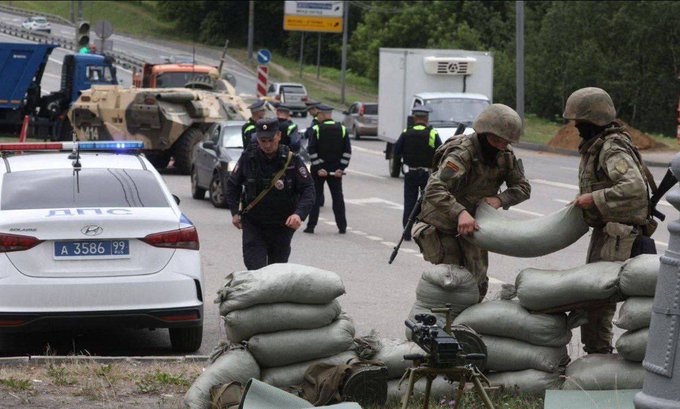
“For Now, The Graduation Balls Have Been Delayed For Just One Week, Moving Around Moscow Has Been Partly Restricted.”

It looks like we have news that overshadows both new Hunter e-mails and the imploded Titanic sub, so of couse, these are the headlines at the conservative Rantingly aggregator as I write this (click on the image for a larger version):
The big thing that's impressed me over the past few months has been how easily Conservative Inc has segued from spring break into Memorial Day into Juneteenth and is now heading into an early Fourth of July. And Labor Day isn't that far off! John Sexton at Hot Air covers it thus:

Normally I don’t work this late but there are potentially world-changing events happening tonight. . . . I’m running out of steam so I’m going to call it a night. I’ll probably update this some more in the morning.

Putin is comparing events to the Whites vs Reds in the 1918 civil war, but ol' John Sexton doesn't like working late. It's all about him as he desultorily skims over history. And it's now morning, but it looks like he's so pooped from last night he just can't get back to it.

It isn't just the elites who act like elites these days. Remember, he earns a salary for this.

So far, US reporting seems to be well behind the curve, whether it's legacy media or Conservative Inc. I've fallen back on Reddit r/Ukrainian Conflict, which carries the most recent reports from a wide range of sources, Russian, Ukrainian, and Western, with the caveat that they're all self-serving in one way or another, and we're looking at major fog of war.

For now, that's all I have to add.

Friday, June 23, 2023

Down With The Old Canoe

There's something evocative about the story of the Titanic sub. It probably owes a lot to the Titanic myth itself, which is reflected in the title of the book Down with the Old Canoe: A Cultural History of the Titanic Disaster by Steven Biel (1997), which according to this review,

". . . seared itself into American memory not because it was timeless but because it was timely". . . . Groups on all sides of the volatile issues of gender, class, religion, and race all found in the Titanic lessons and judgements to bolster their causes.

The much smaller Titanic sub disaster is having the same effect. Biel's title, by the way, is taken from a 1938 country song by the Dixon Brothers:
The lyrics conclude,

Your Titanic sails today, on Life's Sea you're far away
For Jesus Christ can take you safely through
Just obey his great command, over there you'll safely land
You'll never go down with that old canoe

Sailing out out to win her fame, the Titanic was her name
When she had sailed five hundred mile from shore
Many passengers and her crew went down with that old canoe
They all went down to never ride no more

The image of going down and never rising is powerful indeed. That it is now and was then a group of wealthy people reinforces the association. The YouTube psychologist Dr Todd Grande had this to say about Stockton Rush, the CEO of Ocean Gate:

He clearly desired to have extreme, high-risk adventures. Among the wealthy, this appears to be a common sentiment. Several companies are offering trips to orbital and sub-orbital space for price tags ranging from hundreds of thousands of dollars to millions of dollars. Some wealthy people have climbed Mount Everest. For $100,000, a person can visit the South Pole, and, with OceanGate, at least until the Titan disaster, $250,000 would buy a front-row seat to Titanic. What drives wealthy people toward extreme tourism? I think it really comes down to how people find and fulfil purpose in life.

Some people are quite content engaging in safe activities like spending time with family, going to the movies, workng, and reading, but for others, life needs to contain a series of adventures in order to be interesting. The people tend to accomplish one challenging goal, only to move on to another. The purpose isn't found by achieving the goal, the purpose is the never-ending pattern of adventure. It's always having another goal in the crosshairs. When they complete one, they're looking toward another.

When people become wealthy, they may not be satisfied by simply earning more money. There's a point where a person has so much money, they can essentially have anything they want. There is no longer a chance of losing the game. There is no more risk of gettng harmed. It's like playing a video game with an invincibility cheat code. It may be novel at first, but it quickly gets boring. A large quantity of money permits a person to seek an even greater source of stimulation. Just like using drugs, they have developed a tolerance for everything that can give them a rush, so they need a stronger drug.

. . . These wealthy adventurers rationalize the trips by saying they promote science or technology, but in reality, they're just looking for the next high.

This goes some way toward answering my favorite question, "What problem are people like Stockton Rush, Victor Vescovo, and Alissa Heinerscheid trying to solve?" It certainly goes to the issue that their money has, just for starters, bought them admission not just to elite Ivy-level universities, but also to the exclusive prep schools that are recognized as an even more accurate class indicator than an Ivy degree. But that, again, was just the start of an ongoing set of "challenges" for which they already had an invincibility cheat code.

After all, they had degrees from Harvard, Princeton, and Stanford whose prestige comes from a presumably "selective" admissions process, but from the start, they were in separate baskets from the plebes taking SATs and such, they were legacies or the offspring of major donors. The same, we must assume, applied to their corporate careers. All this led to a deep insecurity that they didn't measure up -- and in fact, they didn't. Thus the need to undertake steadily more "challenging" adventures to prove themselves, but these "challenges" were just like all the others, something prestigious that could be bought.

There's something deeply evocative about the meme at the top of this post, a Dylan Mulvaney Bud Light can superimposed on the image of the Titan sub. It goes to the phoniness behind the official culture of our time, and that goes even as far as the legacy media narrative of a "desperate search" for the Titan sub as "time runs out" -- when we now learn that the Navy's sonic detectors told them the sub had imploded within moments of the event, and for whatever reason, it was deemed appropriate to withhold this news for the better part of a week.

The things money will buy.

Thursday, June 22, 2023

The Titanic Sub, The Rich, And The Super Rich

What's held my attention most in the story of the missing Titanic sub is the subplot involving wealth -- and it sounds like much of it is either inherited or of unidentifiable origin -- and a strange subcluture where a clique of wealthy people feed their own deep insecurities. Let's just start with the CEO of OceanGate, Stockton Rush. According to this story,

In past media appearances, Rush appears calm, collegiate and telegenic. With silver hair and business-casual attire, he looks like he might be more at home on the golf course than thousands of feet under the sea. However, questions are now swirling about some of his decisions related to the submersible.

. . . Rush has described himself as having been "born into" wealth and then "grew it," according to a 2017 Bloomberg profile.

The grandson of an oil and gas magnate, he became a private investor alongside working in aviation, earning his pilot's license at the age of 19, the outlet reported.

In 2009 Rush founded OceanGate Expeditions, which remains a private company, with entrepreneur Guillermo Söhnlein, who's since left, according to Bloomberg. Per OceanGate marketing copy, the company is "dedicated to direct human exploration of the undersea world."

It turns out Mr Rush comes from precisely the same social stratum as Alissa Heinerscheid, the Bud Light executive who greenlighted their deal with Dylan Mulvaney: looks the look, talks the talk, rich as Croesus on granddad's money, skating through a corporate career, but on balance doesn't have a clue. Notice the gaseous corporate mission statement, "dedicated to direct human exploration of the undersea world." As far as anyone can tell, this means they take billionaire tourists on sub joyrides, but they give them the cachet of being sorta-kinda idealistic, not just conspicuous consumption.

As soon as the news of the missing sub broke, I couldn't help but think of another member of this small universe, Victor Vescovo,

an American private equity investor, retired naval officer, sub-orbital spaceflight participant, and undersea explorer. He is a co-founder and managing partner of private equity company Insight Equity Holdings. Vescovo achieved the Explorers Grand Slam by reaching the North and South Poles and climbing the Seven Summits, and he then visited the deepest points of all of Earth's five oceans during the Five Deeps Expedition of 2018–2019.

Like Stockton Rush, who has degrees from Princeton and UC Berkeley, and Ms Heinerscheid, who's from Groton and Harvard, Mr Vescovo's background includes the elite St Mark's School of Texas, Stanford, MIT, and Harvard Business School. This suggests his family was more than routinely prosperous, and so far, I've found that his father, from a prominent Tennessee family, was an entertainment executive, but beyond that, my information is sketchy. However, Vescovo himself has acknowledged that he's closely associated with Rush, OceanGate, and the Titanic submersible fiasco: Like Stockton Rush, Vescovo has his own submersible:

Working with Triton Submarines, Victor spent over four years developing a brand-new deep-sea submersible that would be up to this immense task. It needed to be capable of multiple descents into parts of the ocean where pressure levels can reach in excess of 1,000 times that at the surface. The result was DSV Limiting Factor – arguably the most advanced deep-sea crewed vessel in the world right now.

He deploys this submersible from its own "research vessel" mother ship, the Pressure Drop. Although media accounts of his career as an explorer are uniformly adulatory, it's hard to avoid a sense that the whole thing is an elaborate vanity project, and one of his main goals is to be given awards, like The Explorer Medal (2020) and the Captain Don Walsh Award for Ocean Exploration (2021). Here's an interview at Oceanographic:

The Five Deeps Expedition creator Victor Vescovo is no stranger to adventure. In 2017 he completed the ‘Explorers Grand Slam’, having climbed the highest peak of all seven of the world’s continents. This summer, he became the first person in history to have been to both the top of all the world’s continents and the bottom of all its oceans.

We caught up with this intrepid explorer on board the Five Deeps research vessel, Pressure Drop, to find out a little more about where his drive comes from and what his experiences were of heading into previously unexplored ocean areas.

Oceanographic Magazine (OM): You seem to have moved from the world of pure adventure into one of exploration. What prompted that shift?

Victor Vescovo (VV): Well one is a good transition to the other. I guess the transition came from adventuring and mountain climbing – that’s a wonderful thing to be able to do. To then be able to migrate into exploring the areas that nobody has ever been to before is extremely exciting.

So the implication is that he's evolved from rich-guy thrillseeking to something that's sorta-kinda more serious, but in effect, all he's doing is taking himself and assorted science-celebrities on submarine rides and getting awards for doing it. Left unexplained is how he pays for this -- do people pay him a quarter million a pop for the ride, as they do Stockton Rush, or is this entirely an eleemosynary effort? But maybe more to the point, where is the money for all this coming from in the first place?

Both Rush and Vescovo have "research vessels" (Rush's version was listed in 2005 with a reserve price of $1 million) that carry their ultra-submersibles around but seem in fact more like glorified yachts from which they launch ultra-expensive toys. At the same link,

Speaking to Sky News, former rear admiral Chris Parry warned that crafts like Titan 'are essentially kit cars, they're not normal submarines'.

'They're built in an experimental way, and this particular one is, shall we say, built from components you can get off the internet, from Amazon - they're very flimsy, very fragile, and you can't allow a lot to go wrong before you're in danger,' he said.

And at least in the case of Rush's Titanic sub, they can evade any requirements that they meet some sort of certification, although the whole field is so new that nobody seems to know what certification might involve. By the same token, how do you determine projects like Rush's or Vescovo's have any sort of academic or research-related merit?

But there's a bigger question here --why would anyone sign up for one of these sub rides, with Stanford Rush, Victor Vescovo, or any other like them?

A millionaire adventurer who was supposed to go on the Titan voyage said he backed out over fears that the company was “cutting too many corners.” Digital marketing tycoon Chris Brown told The Sun that he paid a deposit of $10,000 to join his friend Hamish Harding after the two decided to go on the voyage after having a “few beers.” Harding is currently on the missing submersible, but Brown changed his mind after learning how the Titan was built.

Well, that was a guy who decided to do something after a few beers but thought better of it the next day. But even among the quasi-seious "explorer" community there were serious doubts:

Veteran explorer Josh Gates, who hosts a TV series investigating myths and legends around the world, revealed Wednesday on Twitter that the missing OceanGate sub "did not perform well" when he went on a dive aboard the vessel himself.

. . . Gates, who hosts "Expedition Unknown" on Discovery, had gone with Stockton Rush, the OceanGate CEO who is now among five missing along with the Titan sub, on a test dive before the vehicle's first visit to the Titanic site.

. . . "To those asking, #Titan did not perform well on my dive," Gates wrote. "Ultimately, I walked away from a huge opportunity to film Titanic due to my safety concerns w/ the @OceanGate platform."

. . . "There's more to the history and design of Titan that has not been made public – much of it concerning," Gates wrote.

. . . Like British businessman Hamish Harding, who is also aboard the missing sub, Gates is a member of the Explorers Club, a research-minded international society of adventurers, many of them very wealthy, including billionaire Amazon founder Jeff Bezos.

So I went looking for the Explorers Club on the web and sure enough, the Explorers Club calls Victor Vescovo an "explorer's explorer" and has given him a medal. We're talking about a tight-knit, highly self-regarding clique of rich guys and wannabes who in fact seem to think well of themselves for engaging in expensive, pointless, and risky thrillseeking activity.

This in turn suggests to me that there are dupes and marks in this population. For instance, there's the Simpson's writer Mike Reiss, who'd been on fully three dives in the Titanic sub:

Reiss has gone on three different dives with OceanGate Expeditions, the company which owns Titan, and that they “almost always lost communication.”

“I got on the sub and at the back of my mind was ‘well, I may never get off this thing,’ that’s always with you,’ he said.

While Reiss allows that Titan is “a beautifully designed craft.”

“This is not to say this is a shoddy ship or anything, it’s just that this is all new technology and they’re learning it as they go along,” he said.

Here's cognitive dissonance at work. Reiss, who's presumably done quite well at the Simpsons and had the wherewithal to pay for three of Rush's joyrides, is unwilling to acknowledge that it was a shoddy ship, it's just that they're all pioneers. After all, Victor Vescovo got a medal, and Reiss probably deserves one, too.

I'm not sure if this is especially new in the world of the super rich. I look back at Hartley Dodge (1908-1930)

the heir to the Remington-Rockefeller fortune. He lived at Giralda Farms in Madison, New Jersey. He died in a car accident in France.

As I understand it, young Hartley was fascinated by airplanes and wanted to undertake flying as a hobby, but his mother forbade this as too risky. Instead, he took up fast cars, which his mother apparently felt was less of a risk, but he killed himself at it anyhow.

Now we have deep-sea submersibles that seem to serve the same purpose. I've got to wonder what sort of need this sort of activity satisfies in this sort of people.
Wednesday, June 21, 2023

Ukraine Counteroffensive A "Suicide Mission"

As I look at this morning's news, I'm beginnoing to think Austrian Col Markus Reisner buried the main insight in the presentation I linked yesterday. I quoted him there:

The West will only support Ukraine as long as the West believes it is important to support the war against Russia, and the West believes the Ukrainian forces are winning.

For now, the second part of his statement is key, and it sounds as if President Zelensky is acutely aware of the problem, especially since Ukraine's winter counteroffensive didn't happen at all, and the spring counteroffensive, which Zelensky announced only on June 8, has apparently now been paused after only a week.

But even as of June 8, the day Zelensky announced the start of the counteroffensive, Forbes reported problems:

A Russian artillery strike on a Ukrainian vehicle column during a daytime assault on or around the town of Novopokrovka—35 miles southeast of Zaporizhzhia city in southern Ukraine—apparently knocked out at least one Leopard 2 tank on Wednesday.

A Russian drone orbited overheard as the shells rained down, its crew presumably helping to direct the strike and assess the resulting damage. The Russians posted the drone’s video on social media, finally achieving what Russian propagandists earlier had tried and failed to do: posit the destruction of a Ukrainian Leopard 2.

The Leopard 2 and other armored vehicles were traveling in an uncomfortably tight column along an unpaved road outside Novopokrovka or nearby Mala Tokmachka—both occupied by Russian troops—when the artillery struck.

By June 10, Asia Times reported deeper issues:

American and European military observers in Ukraine described the Ukraine Army’s efforts of the past two days as a “suicide mission” that violated the basic rules of military tactics. “If you want to conduct an offensive and you have a dozen brigades and a few dozen tanks, you concentrate them and try to break through. The Ukrainians have been running around in five different directions,” complained a senior European officer.

“We tried to tell them to stop these piecemeal tactics, define a main thrust with proper infantry support and then do what they can,” the officer added.

“They were trained by the British and they’re playing Light Brigade,” the officer added, referring to the 1854 disaster at the Battle of Balaclava when misreported orders sent British cavalry into massed cannon fire.

Ukraine’s tanks charged directly into minefields without deploying mine-clearing vehicles first, contributing to the loss of 38 tanks during the night of June 8, including numerous of the newly delivered Leopard II tanks.

Modern Diplomscy added three days later,

Of the 14 Leopard tanks Germany has provided to Ukraine, 3 have been destroyed, along with several of the Leopards provided by Poland.

The Institute for the Study of War, as far as I can determine, deletes each of its daily Ukraine assessments after a few days, so I've been unable to go back to the period June 8-June 12 to see if its reports reflected any of the issues in the links above. However, its June 20 assessment now says,

Ukrainian Deputy Defense Minister Hanna Malyar reported on June 19 that Russian forces have committed significant forces to stop Ukrainian offensives, making Ukrainian advances difficult. Malyar added that ongoing Ukrainian operations have several tasks that are not solely focused on liberating territory and that Ukrainian forces have yet to start the main phase of counteroffensive operations.

Except that in the effort announced by Zelensky June 8 as the start of the counteroffensive, they quickly lost dozens of tanks, including several of the advanced types just sent by the West, in what military observers called a "suicide mission". How's the "main phase" going to go when, or if, it starts?

Both Col Reisner and the ISW refer to an "information space" that, looking more closely at their context, is much better characterized as a "propaganda war". Last year, Ukraine was winning this hands down, with videos showing scenes like farmers towing away abandoned Russian tanks with their tractors. One thing I've noticed in more recent months is there's been nothing new for the Ukrainian side. The war porn on YouTube and Twitter shows just the same old vignettes of Ukrainian drones dropping grenades on Russian trenches, with occasional analyses showing Ukrainian missile attacks on bases in Crimea accomplishing nothing.

Beyond that, Oryx, the open-source intelligence blog that had become the go-to place that documented equipment losses on both sides of the Russo-Ukraine war, announced over the past several days that it was ceasing operations:

I would hereby like to inform you that I will be ending Oryx on October 1st. I originally started Oryx Blog 10 years ago to cure my boredom. Little did I know Oryx would escalate into the all-consuming project it is today. All of us work on the articles and lists in our free time. It's not our job. We don't get paid. Though I hoped our work would one day lead to a job, no such thing occurred. Oryx just doesn't make me happy anymore, and continuing with it prevents me from finding a happier place in life.

According to Wikipedia,

The blog gained international prominence through its work during the 2022 Russian invasion of Ukraine, counting and keeping track of material losses based on visual evidence and open-source intelligence from social media. It has been regularly cited in major media, including Reuters, BBC News, The Guardian,The Economist, Newsweek, CNN, and CBS News. Forbes has called Oryx "the most reliable source in the conflict so far", calling its services "outstanding". Because it reports only visually confirmed losses, Forbes claimed that Oryx's tallies of equipment losses have formed absolute minimum baselines for loss estimates.

There is no question that since the start of the war, Oryx was seen as objective support for Ukraine's side. Oddly, it doesn't look as though anyone saw fit to give it financial support, although the ISW gets heavy funding from the US defense industry -- but try as the ISW might, it's never carried Oryx's credibility.

All this adds to a sense that since last fall and the lack of any new counteroffensive, Ukraine was losing, and had begun to recognize it was losing, the "information space", or better expressed, the propaganda war. Just as spring was about to end without any promised spring counteroffensive, Zelensky announced this had begun -- but it sounds as though within a week, and probably even within days, this had effectively been called off, with lame explanations that it hadn't really started anyhow.

Col Reisner is correct, though, the West will only support Ukraine as long as it thinks Ukraine is winning. My own position on the war in the middle of last year was also based on the assumption that Ukraine would keep winning -- but it's important to recognize that the wartime leaders to whom I compared Zelensky at the time, Lincoln, Churchill, and Roosevelt, were acutely aware of the need for victories to sustain public support for wartime sacrifice. Thus they needed, and knew they needed, Vicksburg, Gettysburg, El-Alamein, Midway, and Guadalcanal, and they pushed hard to get them.

For whatever reason, Zelensky seems to have lost sight of that important part of his job, and it looks right now as if, belatedly recognizing it, he's now desperate. This doesn't augur well, and it lends support to the Trump-Tucker Carlson view of rhe war.

Tuesday, June 20, 2023

Ukraine's Spring Counteroffensive Falters

As of June 11,

Ukraine's President Volodymyr Zelensky appears to have confirmed that his country's long-awaited counter-offensive against Russia has started.

"Counter-offensive and defensive actions are taking place," he said.

But he added that he would not talk in detail about which stage or state the counter-offensive was in.

The comments come after an escalation of fighting in the south and east of Ukraine and speculation about progress of the widely anticipated push.

But as oif June 18, only a week after that announcement, The Institute for the Study of War reported,

Ukrainian forces may be temporarily pausing counteroffensive operations to reevaluate their tactics for future operations. Head of the Estonian Defense Forces Intelligence Center Colonel Margo Grosberg stated on June 16 that he assesses "we won't see an offensive over the next seven days.” The Wall Street Journal similarly reported on June 17 that Ukrainian forces “have mostly paused their advances in recent days” as Ukrainian command reexamines tactics.

A month ago, I noted that an expected Ukrainian spring counteroffensive was being steadily delayed despite predictions that it would take place first in April, then in May. Now, with just days left in spring, it sounds like the spring counteroffensive won't take place at all, at least this spring.

The ISW hedged its report farther down:

ISW has previously noted that Ukraine has not yet committed the majority of its available forces to counteroffensive operations and has not yet launched its main effort. Operational pauses are a common feature of major offensive undertakings, and this pause does not signify the end of Ukraine’s counteroffensive.

But the neoconservatives behind ISW are precisely the same people who brought us the quagmires in Iraq and Afghanistan, amid a dozen years and more of happy talk about progress. The ISW as of yesterday resumed the narrative as though its report of June 18 never happened:

Ukrainian forces conducted counteroffensive operations in at least three sectors of the frontline and made gains on June 19. A Russian milblogger reported that Ukrainian troops continued attacks northwest, northeast, and southwest of Bakhmut on June 19 and claimed that Ukrainian forces advanced near Krasnopolivka (about 12km northeast of Bakhmut).

The problem I see is that these reports haven't changed qualitatively since last November, when Russian forces left the city of Kherson. That was the last tangible progress for Ukraine in the war. The latest English-language video from Col Markus Reisner of the Austrian military academy sums up the current situation at the top of this post. As of last year, I'd begun to lose patience with Col Reisner, as I thought he was too pro-Russian in the face of last year's Ukrainian military successes. Apparently I wasn't alone, as he begins his presentation:

Before we start, I would like to say thank you for all the feedback we are getting for our videos. I would like to state very clearly that it is obvious who is the aggressor and who is the defender. But I would like to stay as neutral and objective as it is possible. Therefore we need a clear picture of the situation along the front lines. It doesn't help to underestimate the Russians and to overestimate the Ukrainians, especially it is not helpful to the Ukrainian armed forces.

My takeaway from his overall assessment is that the Ukrainians are likely to try to recapture Crimea as their main priority for the year, but this strategy will demand both a second destruction of the Kerch bridge and a severing of the Russian land connection north of the Azov Sea. This is a tall order.

But he also switches to what he calls the "information space" of the war, which I would actually, and I think more accurately reflecting his meaning, call the propaganda war. He says,

The West will only support Ukraine as long as the West believes it is important to support the war against Russia, and the West believes the Ukrainian forces are winning. On the other side, we have the center of gravity of Russia, and this is the Russian people, who are close to the regime and who are willing to assist with all the needs the regime considers necessary to fight a long war against Ukraine. And here it is the aim to make the Russians believe that they are fighting a wrong war and that they are losing.

He concludes with an assessment that

the American strategy obviously is called "boiling the frog", that means the Ukrainians will get what they need, but not more. And the question is why is that the case? Well, it looks like the Americans want to avoid to corner the Russians and escalate the conflict.

I'm not sure if Col Reisner fully understands the English-language analogy of boiling the frog:

The premise is that if a frog is put suddenly into boiling water, it will jump out, but if the frog is put in tepid water which is then brought to a boil slowly, it will not perceive the danger and will be cooked to death.

I suppose Col Reisner means that the American strategy is to lull the Russians into fighting a long war, but gradual but imperceptible Western escalation will somehow kill the Russians slowly without their noticing. The problem I see is that time isn't on the Western, or Ukrainian, side. If the neoconservatives have their way, well, yes, by 2025 or whenever, we'll have supplied the Ukrainians with F-16s and Abrams tanks, but the Russians won't notice, and we'll have chased them out of Ukraine by 2028 at the latest.

The problem is going to be that there's an election campaign under way, and Trump, the current front runner in both the primary and potential general matchups, is advocating a settlement. Even if Trump's prospects decrease, other Republicans, and potentially even Democrat challengers, will advocate settling the war as opposed to years of further struggle. This is an aspect of the "information space" that Col Reisner gives too little attention. He does assess, though, that the West will only support the war as long as it believes Ukraine is winning.

Ukraine basically has until fall of this year to make that case, or a Republican will force a settlement on both parties. This has been a flaw in the Western strategy that's bothered me since the middle of last year: there's no clear end state, especially in the Biden-Blinken strategy on the war. Boiling the frog is not a strategy, it's an attempt to pretend something isn't happening.

Monday, June 19, 2023

Biden Being Biden

Axios ran as piece over the weekend that supports my view of Biden's Friday "God save the queen" remark that I ran on Saturday:

Biden’s quirky aphorisms are sometimes weaponized by Republicans to insinuate the 80-year-old president is in mental decline. But Biden has been using unique phrases for years — but even some of his aides aren't exactly sure what he means by them.

. . . Biden also said, “God save the queen,” when he was vice president in January 2017, after he certified Donald Trump's 2016 election victory, The Telegraph reported at the time.

The story noted that they'd asked several Biden aides what he meant by the phrase, but none could give a clear answer. But it went on,

During this year's State of the Union, he told Republican lawmakers, “Lots of luck in your senior year.”

Some Biden allies believe that's his way of saying, "Good luck with that." But at the time, the White House declined to tell The New York Times what he meant — and some administration officials still chuckle about how they don’t quite know, either.

The first thing I would point to is, again, the problem of the Dunning-Kruger Effect as it relates to humor: people who suffer from it think they're being funny, when nobody gets the joke. And those who study Biden's speech are finding that he actually repeats his strange phrases, as he now has done with "God save the queen". Whatever he means by it, he seems to use it in a particular private context that he thinks is funny.

My surmise is that it's a shorthand for "balderdash" or something like that -- in 2017, he certified Trump's electoral victory and essentially commented "balderdash". In 2023, he uttered a string of conventionally patriotic sentiments at the University of Hartford before explaining he wouldn't shake hands with the audience and then essentially commented it was all balderdash anyhow.

The subtext here, I think, is he's the most powerful man in the world, he can utter cryptic phrases that can easily enough be parsed out to mean he doesn't think much of his audience, and they've just got to deal with it. Two years ago, I noted Biden's disdain for anyone who objected to his abrupt withdrawal from Afghanistan, which I said at tht ime

fits what I'm coming to see from this sort of offhand remark is Biden's view of himself as a skilled Machiavellian manipulator, operating in a behind-the-scenes dimension of Realpolitik beyond conventional expectations.

This brings me back to the Dunning-Kruger Effect. Frankly, I don't think I ever had a boss (maybe with one or two exceptions) who didn't suffer from the Dunning-Kruger Effect. None, for instance, was ever promoted from the ranks of people who did the actual work their subordinates did, but since they were the boss, they assumed they could do it. (I sometimes got in trouble for asking such a boss, complaining about something i'd done, to show me how to do it right. That sort of question was beyond the pale and showed I was a troublemaker.)

But this goes to the simmering resentment that underlies Dunning-Kruger. One of my worst bosses was a lady who spent her days driving around San Francisco-area freeways, ostensibly supervising various activities at different sites, except she never quite stopped her car to supervise anything. She just drove around, calling everyone from her car, and I don't rule out that she was plastered as she did this as well. She had her job because she'd been promoted at some company that had been merged into the current tech giant years before, and she'd just ridden the wave of mergers and acquisitions ever since. She had no idea of how actually to do any of the work.

She'd punctuate her calls with snarky little remarks like "sh*t rolls downhill" and "I hate my life", knowing there was absolutely nothing any one of us could do about it -- but I also think that behind those remarks was a seething resentment at the worker bees who could actually do their jobs, which she could not. She could fire any of us, and she often did, but we could land on our feet and get new jobs, because we knew how to do the work. She hated us for it.

I think something like that, a vestigial remnant of rudimentary conscience, is behind Biden's cryptic remarks. He rose to the presidency in an election that, if not stolen outright, was certainly hinky, and he was nominated in the first place because, at long last, he was the only credible Democrat alternative to Bernie Sanders. Other than not being Bernie Sanders and not being Donald Trump, he had no other qualifications for the job, except, as he suffered from Dunnng-Kruger, he was utterly convinced he was the man for it.

And he hates the voters who put him there. Down deep, and maybe not even that deep, he knows the jokes he keeps telling aren't funny, he knows his audience knows it, but he keeps telling the dumb stories and making the dumb remarks because people have to listen and make the best of it. I don't think even Dunning or Kruger understood that part of the Dunning-Kruger Effect -- the point is to make the competent suffer.

The Axios story concludes, and I endorse this:

There are legitimate questions about Biden's age and stamina as he runs for a second term — but his off-beat proverbs are just Biden being Biden.

Sunday, June 18, 2023

Fought To A Draw

The headlines at the right-wing aggregators were misleading: Dodgers Wind Up With About 60 People Attending The Game For Their Anti-Catholic Stunt. What actually happened was that the Dodgers, caught between a rock and a hard place, split the difference and gave the Sisters of Perpetual Indulgence their community hero award at a ceremony on the field but considerably before the actual game. (Most of the aggregators, including Breitbart at the link, eventually clarified this.) The 60 people who were there were just a select group watching the little pre-game ceremony. Nevertheless, a few booed loudly.

So the Dodgers' strategy was to finesse the "sisters" without re-un-disinviting them, without an apology or even a direct acknowledgement of the problem, and hope it all blows over. This has mirrored the corporate strategies of Bud Light and Target, as well to a lesser extent other companies like Kohls and Starbucks, which have quietly removed Pride Month signage and merch in hopes this will avert the consumer boycotts that consumed the other two.

This response by the corporate mainstream to date has been remarkably pusillanimous, and so far, it hasn't fixed things.

Anheuser-Busch CEO Brendan Whitworth plans on hitting the road this summer amid major issues with Bud Light.

The alcohol powerhouse company has seen its stock price get hammered and Bud Light sales collapse ever since BL decided to team up with Dylan Mulvaney.

The incredibly stupid March Madness promo featuring the transgender activist was more than two months ago, but the bleeding just doesn’t stop.

Sales were down more than 24% in the latest data.

The "listeing tour" strikes me as a last-ditch attempt by CEO Whitworth to hold onto his job, but still without an apology or acknowledgement of the problem. In fact, it's just a continuation of the strategy that's put them where they are now: pretend it was a little glitch, fire the lower-level managers involved, and tell the distributors they'll sorta-kinda fix it down the read.

But was Corporate America caught by surprise here? I'm not so sure. As I pointed out in this post, professional hockey players resisted wearing "pride" logos on their jerseys as early as January of this year, well before the Bud Light controversy broke out. Fully a year ago, five Tampa Bay Rays players refused to wear "pride" logos for the team's 2022 Pride Night. Although Major League Baseball appears to have solidified a policy of not requiring players to wear "pride" insignia in the wake of the Dodgers fiasco, this had already been raised by the players' union over the past year.

With June being Pride Month, Major League Baseball Commissioner Rob Manfred was asked Thursday following the owners meetings in New York about the possibility of LGBTQ+ Pride celebrations being standardized leaguewide in the future.

Each individual club currently makes the determination of whether to host a Pride-themed night, but Manfred said Thursday that the league has discouraged teams from wearing Pride logos on their jerseys this season to "protect" the players.

As I've said here already, the issue in professional sports is that the star players have individual brands, which are valuable for endorsements and retirement income. As Bud Light made clear, the wrong sort of association can badly damage a brand, and wearing a totem that endorses the gay lifestyle can do just that, since it can carry the implication that the player himself is gay. The players' union was aware of this well before Bud Light, and Major League Baseball has been brought into line with the program.

But there's clearly a bigger trend.

The annual meeting of the Southern Baptist Convention voted to affirm a decision made earlier this year to remove Saddleback Church, a major southern California congregation founded by the pastor and author Rick Warren, due to its having women pastors.

Representatives at the conference in New Orleans overwhelmingly supported the decision to expel the church, according to the vote count reported Wednesday morning, despite pleas a day earlier by Warren, the author of “The Purpose Driven Life.” The representatives, known as messengers, also voted to affirm the ousters of two other churches, including Fern Creek in Louisville, Kentucky, which has had a female pastor since 1993.

The vote to uphold those removals came just a few hours before a two-thirds majority of the Southern Baptist Convention – the largest Protestant denomination in the United States – separately voted to approve an amendment to its constitution that would more broadly prohibit churches from having women hold any pastoral title.

Contrast this with the contemporary schism in the United Methodist Church, which is the second-largest US Protestant denomination after the Southern Baptists, in which the Methodists, while acknowledging division over the issue of sexuality, simply offered the conservatives an amicable divorce, allowing them to leave but retaining control over the brand. In contrast, the Southern Baptists told the liberals to get out and kept the brand as well.

The Methodists in turn were trying to avoid the precedent set by the Episcopalians two generations earlier, whereby dissidents walked out with their property, causing decades of wasteful litigation while destroying that denomination's carefully nurtured prestige. In fact, learning nothing, they repeated the same pattern, first in the 1970s over ordaining women and then in the 2000s over gay bishops, with the end result that traditionally stable careers for all but a few Episcopal clergy have disappeared.

It looks to me as if the Southern Baptists finally reversed this Protestant trend of feckless piecemeal appeasement, which is why they're going to continue as the largest Protestant denomination in the US, unlike the Episcopalians, which were always the smallest.

The overall picture suggests to me that the more observant Christian and Jewish denominations have begun to fight secularism to a draw, something that started with the lawsuits over the COVID lockdowns. I think about the 1916 naval battle of Jutland, which was in fact a near-defeat of the British, but its effect was to keep the German fleet in port for the rest of thr war, which was one factor that led to an eventual German defeat in 1918. I think the 2023 Battle of Bud Light may be something similar in a much more extended conflict between the forces of secularism and the forces of natural law.

At minimum, the forces of secularism have at least temporatily lost the initiative, and official pusillanimity has begun to prove an ineffective strategy.