Tuesday, October 12, 2021

Crisis Management??

Two weeks ago, the news was that Vice President Harris had brought in a crisis managemet team to help her public image.

LORRAINE VOLES was one of two hires, along with former Obama speechwriter ADAM FRANKEL, reported by both the Washington Post and CNN over the weekend. Both worked for the vice president during the transition, and “offered to be of assistance,” an official from the White House said. A Harris aide said Voles and Frankel began their new roles in August.

Although the White House official didn’t use the word “crisis,” Voles is well known as a public relations and crisis communications expert. She most recently led crisis communications at George Washington University and at Fannie Mae, after serving as a strategist and adviser to HILLARY CLINTON’s 2006 Senate reelection race and 2008 presidential bid. In the late ‘90s, she helped AL GORE craft his message as vice president. Now she’ll help Harris with long-term planning, her policy agenda and with “organizational development” and strategic communications, according to a White House official.

But over the weekend, her bizarre performance in a scripted video feature with child actors can only have made the crisis worse.

The first installment of Vice President Kamala Harris’s YouTube Originals space series featured child actors who auditioned for their roles in the project.

Trevor Bernardino, a 13-year-old actor from Carmel, California, and one of five teenagers featured in the video, was asked to submit a monologue discussing something he is passionate about and three questions for a world leader, according to an interview with KSBW TV. Trevor then interviewed with the production director.

. . . “It was pitched to my son and us as a pilot,” [the actor's father] said, but whether it continues will “depend on the reaction and what the producers want to do — our hope is that it gets picked up.”

. . . The video, which by Monday had garnered some 114,000 views on YouTube, as well as 1,900 likes and 2,800 dislikes, was shared online by the vice president’s aides and supporters. A trailer for the show drew 48 likes and 136 dislikes. Comments on both videos have been disabled.

. . . In one segment, Harris expounds on the virtues of space exploration and scientific discovery.

. . . Paired with the caption, “Me when I miscalculate a micro dose and start fully tripping midday,” the clip has been viewed close to a million times.

Well, it doesn't inspire confidence that Ms Voles's prior clients include Hillary Clinton and Al Gore, two people who, the more we saw of them, the less we liked them. Gore in particular needed a competent crisis manager after the "release my second chakra" episode, whether he had one on the payroll or not. He certainly could have afforded one. But this goes to the question of judgment. As the massage story developed in his case, it appears that he had a habit of bringing massage therapists into his room in high class hotels and propositioning them for sex acts.

There's not much a crisis manager can do when you keep creating new crises for yourself. The same applies to Vice President Harris. Her problem is that she keeps cackling in inappropriate situations, giving herself the appearance of being unserious and disengaged. A real crisis manager would have to sit her down and and tell her to start acting like a senior politician if she wanted people to think of her as one. Instead, she comes off as if she's tripping. (I definitely don't rule it out that she is.)

But if the producers involved with that video anticipated what the reaction would be, why didn't her handlers simply insist it not be released? What on earth is she paying Ms Voles for she didn't axe that whole project? I would guess that only a crisis manager who badly needed the work would take that job.

Sunday, October 10, 2021

Here's Another Puzzle For Traditionalists

Speaker Pelosi has been at the back of my mind as I've considered the question of whether the Latin mass made more reverent Catholics when it was the norm, but an incident inolving her in Rome this weekend brought it to the fore:

Pelosi was given the honor of meeting with the Pope on Saturday.

Pelosi was also invited to do a reading during Mass at St Patrick’s Catholic American Parish in Rome. But there was some form of a “security incident” according to Paulist Fr. Steven Petroff, rector of St. Patrick’s, who was saying the Mass. The Rome correspondent for The Epoch Times described it as Pelosi being “heckled.”

We know little else about the incident, except that according to Fr Petroff, there was some type of disruption that caused her security detail to take her out of the mass before she could do the second reading, which would be Hebrews 4: 12-13:

12 For the word of God is living and effectual, and more piercing than any two edged sword; and reaching unto the division of the soul and the spirit, of the joints also and the marrow, and is a discerner of the thoughts and intents of the heart.

13 Neither is there any creature invisible in his sight: but all things are naked and open to his eyes, to whom our speech is.

If I were she, I might take the circumstances as a caution of some sort, but I doubt if she even gave the passage any thought or study before she was going to read it. It may as well have been in Latin.

Which brings me to yet another puzzle: Pelosi, born in 1940, would have been confirmed in the early 1950s, well before any innovations in the Church. She would have been 30 by the time the novus ordo was promulgated, in other words a cradle Catholic fully formed by adulthood, all of that time hearing the mass in Latin under the old calendar and lectionary. According to traditionalists, this is just the thing that will restore the Church, right?

So how come Pelosi is at odds with the very wing of the Church that's most sympathetic to traditionalists? I suspect her own Abp Cordileone would have problems with her serving as a lector within his archdiocese (I don't know if she ever does -- if anyone knows, I'll be interested to hear). And I think this goes to the question of how the Church has changed since Vatican II.

Keep; in mind that Pelosi and President Biden are both in the mold of US Catholic politicians formed before Vatican II, most prominently the Kennedys but including others like Dan Rostenkowski, who eventually served 17 months in Federal prison for corruption.

All visibly attended mass, but I very much doubt if any ever went to confession, or if they did, it never had much effect. None seems ever to have had a problem with the public scandal he created, but they were all happy to campaign on the Catholic brand.

It's plain that the US bishops are less and less comfortable with that sort of arrangement, and Abp Cordileone has been increasingly vocal in his warnings to Pelosi that Catholic politicians shouldn't campaign on the brand if they don't support Catholic teaching.

This is a post-Conciliar development and a good one. It's reflected in a YouTube presentation by Bp Barron prior to the Catholic Paul Ryan's retirement as Speaker suggesting that Republican views like Ryan's were incresingly acceptable to Catholics and, by extension, the Catholic hierarchy. Ryan, born in 1970, was also formed entirely under novus ordo.

One clear intent of the Vatican II constitutions that produced novus ordo was to increae lay involvement in the mass and, by implication, the overall life of the Church. It's significant that somehow a vetus ordo machine politician like Speaker Pelosi should find herself in difficulties trying to participate in a novus ordo mass, in Rome, so soon after meeting with the pope.

But the changes go beyond that. There was nothing new in the clergy abuse scandal. Cardinal McCarrick, born in 1930, was convicted of abuse committed in the 1990s but was almost certainly part of a pattern over a much longer period, and which wasn't unique in the pre-Conciliar, Latin mass hierarchy. It was only in a post-Conciliar environment that laity could play a major role in addressing this problem.

I don't see how a return to the bad old days helps anything.

Saturday, October 9, 2021

Let's Get Back To The Latin Mass Question

For some time, I've been in the habit of revisiting what I thought I knew about the Catholic Church when I was a lot younger, vis-a-vis what I've learned since converting. Just in the last few days, it occurred to me that I knew a lot of Catholics in high school, college, and early adulthood, and that shouldn't be a surprise, since Catholics are the largest religious denomination of any sort in the US. Not only that, but I was always at least somewhat interested in Catholicism, though I was raised Presbyterian. If nothing else, I wanted to know how so many people could be so wrong over so many centuries.

I was born in 1947, as were the Catholics whom I knew in my age cohort. I could probably list two dozen names among fairly close friends, as well as girls and women I dated, and they would have been a large proportion of people who were more than just acquaintances in my youth. And this means we can extrapolate: if they were early baby boomers like me, they would have been confirmed at about age 12, which is to say in the late 1950s, not only before Vatican II, but well before the introduction of the Paul VI mass in 1970. They were raised, formed, and initiated as pre-Conciliar Catholics.

What I began to realize once I followed this train of thought was that, by the time I knew them in their mid to late teens and into early adulthood, none was still an observant Catholic. This would be in a ten year span, between about 1965 and 1975. Of the two Catholic women I dated in my single years after college, both were already divorced. (One had shot her husband, but it was an accident. There's more to that story.) All these people had been formed as Catholics prior to novus ordo, and nearly all had come to a conclusion that, while they still identified as Catholics, their Catholic formation had been a serious handicap, something to be overcome.

I would also say that most still regarded the Catholic brand as something prestigious, an indication that they were serious people and not superficial. Their problem was they felt this had made them neurotic and guilt ridden. And they'd gotten this way before novus ordo was even a glimmer in a cardinal's eye.

I'll grant that this is anecedotal and subjective, but I think it reflects what had become of Catholicism in popular culture, and in fact in Catholics' view of themselves, by the 1950s. The 1979 play Sister Mary Ignatius Explains It All For You is clearly based on pre-Conciliar stereotypes of Catholic education, including a teacher who is a religious fanatically inculcating a sexually repressive, anti-Freudian world view. Fulton Sheen in his televison presentations of the period, also pre-Conciliar, clearly recognized this threat to Catholicism posed by the view of psychoanalysis and its efficacy in popular culture.

But let's put this in the context of the current Catholic traditionalist movement, especially the view that the Latin mass is a revival of a somehow purer Catholicism. Let's take what I think is a representative expression of this view, Ten Reasons To Attend The Traditional Latin Mass, The reaons include:

2. What is true for me is even more true for my children. This way of celebrating most deeply forms the minds and hearts of our children in reverence for Almighty God, in the virtues of humility, obedience, and adoring silence. It fills their senses and imaginations with sacred signs and symbols, “mystic ceremonies” (as the Council of Trent puts it).

The problem here is that the Catholics I knew, in the last generation to be fully formed in the old Latin mass Church, hadn't been effectively formed in it. By adolescence or early adultood, they'd all fallen away, and they all felt their Catholic upbringing was a handicap to be overcome. Not just some of them, all of them.

The piece sums up:

Similar points could be made about the distracting “Sign of Peace”; or female lectors and EMHCs, who, apart from constituting an utter break with tradition, can be clad in clothing of questionable modesty; or the almost universal custom of loud chitchat before and after Mass; or the ad-libbing and optionizing of the priest.

This is a straw man argument that conflates innovations that, whether you agree with them or not are sanctioned by the Church, with accidents like skimpy clothing, chitchat, or a skylarking priest that may or may not be present in a novus ordo parish-- and indeed, there's nothing to prevent them from happening in a Latin mass. The piece goes on:

This point should be emphasized: it is especially harmful for children to witness, again and again, the shocking lack of reverence with which Our Lord and God is treated in the awesome Sacrament of His Love, as pew after pew of Catholics automatically go up to receive a gift they generally treat with casual and even bored indifference.

I would say again that in my admittedly anecdotal experience and my subjective view of it, every Catholic I knew in my age cohort, formed as children in the universal Latin mass environment of the 1950s (and indeed, some older Catholics I knew at the time) had lapsed and felt their Catholic formation was a handicap well before novus ordo came on the scene.

It's also plain that figures like Fulton Sheen were aware of factors like Marxism and psychoanalytic theory that were challenging Catholicism well before Vatican II. I've been carefully reading Lumen Gentium and Gaudium et Spes, and it's plain that the Council was aware of these and many other factors that were challenging the Church, and they recognized that these were not simple problems, and the Church would be dealing with them for centuries to come.

To regard the Latin mass as some sort of panacea that will stop the erosion of observant Catholics is simplistic and reflects an inability to recognize trends that were well under way before Vatican II.

Friday, October 8, 2021

Dr Collins Never Did His Job

Over the past few days, I've noted an anomaly: Maine is being hammered with COVID cases despite having one of the highest vaccination rates in the US:

A week ago, I noted Maine was having a surge in COVID-related hospitalizations. This happened despite 84% of everyone over 12, 85.3% of everyone over 18, and 98.4% of everyone over 65 are at least partially vaccinated.

Maine's policies on masking follow CDC guidelines. But here's a graph of Maine's COVID cases as of this morning:
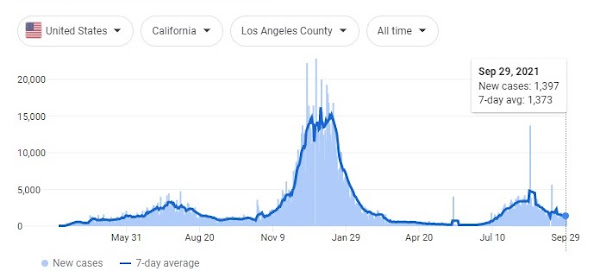
On the other side of the country, Los Angeles County's statistics show a remarkable difference:
In contrast to Maine, only 77.9% of the population is fully vaccinated. While the county has an indoor masking requirememt, as opposed to Maine's recommendation, the effectveness of masks is at best debatable -- but given the disparity we see here, so should be the effectiveness of vaccines. In fact, LA County is even mooting dropping its mask mandate:

“I’m very cognizant that when we introduced the mask mandate in June, we noted that it was really related to increased transmission and feeling like we needed to add another layer of protection,” Public Health Director Barbara Ferrer told the Board of Supervisors Tuesday. “And I think we did the right thing. But I also am aware when we have very low transmission and more people vaccinated, it doesn’t necessarily make sense to keep that mask mandate everywhere, assuming of course that we don’t have a dangerous variant that we need to protect ourselves from.

So what's the difference between Maine and LA County? As a mere English major who never had an epidemiology course, I would venture the guess that LA County's very high COVID peak in the late 2020 surge left a large proportion of its population with natural immunity, and this was responsible for its unusually low peak in the Delta surge this past summer. Just as an informed observer, I would think that this is confirmation for the consensus that's quietly emerging that vaccines have proven less effective than natural immunity, so much so that vaccines alone haven't performed much better than masks, social distance, or lockdowns in controlling the pandemic.

Notwithstanding, with COVID essentially under control, Los Angeles City, which is only part of the county, just imposed a new vaccine mandate itself thst goes beyond the county.

ABC7 reports that Los Angeles Mayor Eric Garcetti signed a city ordinance requiring all people within the city of Los Angeles “to show proof of full COVID-19 vaccination before entering indoor restaurants, bars, gyms, shopping centers, entertainment venues, and personal care establishments.”

Garcetti signed the ordinance a few hours after the Los Angeles City Council passed the COVID-19 vaccination proof measure which is “considered one of the strictest in the nation”[.]

So we have a situation where measures that are clearly overkill are adopted in an area where the problem is generally under control, while vaccinations are proving no more effective than masking, social distance, and business closures in other areas.

What answers can the National Institutes of Health (Dr Collins), which subsumes the Centers for Disease Control and Prevention (Dr Walensky) and the National Institute of Allergy and Infectious Diseases (Dr Fauci)) give us that might help policymakers and the public understand this problem? Remember, COVID has now been with us for fully two years, yet the effectiveness of this estalishment's solutions, including the wildly expensive and by now overhyped vaccines, has been marginal at best.

In a just universe, Dr Collins's retirement might well have been the result of a quiet request from the administration in light of his poor leadership over this period. A theoretical Trump-like president -- not necesssarily Trump himself -- would initiate a careful and thorough high-priority search for a replacement.

Such a search woukld recognize the need for a leader who could credibly advocate common-sense precautions across the board. Instead, after two years, all we have is a vacuum that allows opportunistic power grabs by local politicians. I can't imagine Dr Collins's replacement will be any improvement.

Thursday, October 7, 2021

Did McConnell Fold?

I have a different take from nearly everyone else on the likely outcome of the debt ceiling negotiations now under way. Trump and most conserative commentators are claiming Mitch McConnell "folded" in offering thr Democrats a potentiazl way out of their debt ceiling dilemma. But as soon as I saw the offer, I thought this looked much more like a calculated maneuver. The two choices he gave were, first, to abandon the full $3.5 trillion reconciliation package in exchange for the Republicans not filibustering the debt ceiling. '

The other choice was a two-month extension of the ceiling, limited to current levels of borrowing, that would give the Democrats time to put together a deal that would allow them to extend the ceiling farther through reconciliation. This, I would think, is a version of Staff Work 101, in which the staff puts together a menu of options for the decisionmakers that steers them in the direction the staff wants them to go. Typically it's one option that's too hot, one that's too cold, and one that's just right. The object is to steer the bosses toward the option they can conclude is the just right one.

The McConnell version was just two options, one completely unacceptable (drop the whole $3.5 trillion package) and one distasteful but acceptable in light of the other, impossible option (kick the can down the road). Option two had rhe additional advantage of letting the Democrats spin it as McConnell "folding".

The only intelligent analysis of the situation I've seen is consistent with my take:

Sometimes, the best thing you can do when you don’t otherwise have much leverage (because you are in the minority) is to give your opponents options they do not want. Democrats want you to believe that the only way to raise the debt ceiling without Republicans playing along is to blow up the filibuster. That’s why they and their media allies keep spinning that narrative. That’s never been true, though, and the point of McConnell’s maneuver is to force Schumer to admit that.

In reality, Democrats can raise the debt limit via reconciliation without a single Republican vote, but they don’t want to go that route because they would be using the last bullet in the chamber on that after Biden’s “build back better” boondoggle. By offering Schumer a short-term extension, McConnell is forcing the Democrats to make a choice, and none of those choices includes blowing up the filibuster. The move also relieves pressure on Joe Manchin, who will be under immense assault if a shutdown happens, while at the same time highlighting that the Democrats could fix this themselves in short order if they wanted.

When analyzing these machinations, you have to accept that a long-term default is not going to happen. The debt ceiling will be raised eventually. The question is how it’s done and who pays the political price.

This last observation is the one Trump and everyone else is ignoring. I haven't seen a single explanation from anyone of how a debt default would be a good thing. At best, it would be a disaster well above the Afghanistan pullout on the Richter scale of such things, and while you could argue it would be awful for Biden, it would be awful for everyone else, too. It would simply be a new COVID level disruption. We don't need that, espeically now.

But let's add my incompetence model to how this games out. Remember that a key factor in incompetence is the inability to understand how the calendar works. The agreement that appears to be emerging is to extend he debt ceiling deadline by two months. Looking at the congressional calendar, after the House and Senate return on October 19, allowing for Veterans Day and Thanksgiving recesses, there are only six legislative weeks for the Democrats to complete their reconciliation package, which they now expect will include the extension on the debt ceiling.

They've had all year to come up with the $3.5 trillion package alone, which Speaker Pelosi herself acknowledged was "not ready" for the leftists to vote on by last week. Since then, Pelosi has left for Europe, so not much will get done until she returns.

But added to the inability of the Democrats to finish even the original $3.5 trillion package, it's now understood that this will need to be severely cut to meet Joe Manchin's demands. And beyond that, the objective is now also to bring the bipartisan infrastrsucture bill with the reconciliation package into a single House vote. Finishing a task like this in six weeks is a challenge even for capable people. The problem is that there aren't capable people in that talent pool. My estimate is that this will, as the last effort did, collapse into a "we'll work all weekend to get it done" fantasy.

I think McConnell has gamed this thing out pretty well.

Wednesday, October 6, 2021

NIH Director Collins Announces His Retirement

I speculated last June that Dr Birx, who throughout 2020 had been a full co-spokesperson with Dr Fauci for the COVID establishment, announced her retirement when she no longer felt comfortable with the conflicts between her private behavior -- viz, her willingness to travel for holiday family gatherings in opposition to the policies she endorsed -- and the public example she was expected to set. Since she would soon turn 65, this was an easy out for her.

At the time, I noted that her boss, Dr Francis Collins, was 71 and seemed to show no such inclination to let go, any more than Dr Fauci has at 80. But now Dr Collins has changed his mind and intends to retire by the end of the year. His reasons are the usual bormides:

I love this agency and its people so deeply that the decision to step down was a difficult one, done in close counsel with my wife, Diane Baker, and my family. I am proud of all we’ve accomplished. I fundamentally believe, however, that no single person should serve in the position too long, and that it’s time to bring in a new scientist to lead the NIH into the future.

But, having served six years past normal retirement age already and, with the implicit example of Dr Fauci showing that such Deep State appointments are effectively for life, why has he chosen to retire now, rather than ten years from now? He's already held his position for a record time. How long is "too long"? Apparently for him, "too long" is after the end of this year, or something like that. (My uncle retired as a corporate CEO giving the private reason that a CEO's shelf life is six to eight years. Dr Collins gives no such criterion.)

The mainstream media doesn't investigate further. But from historical examples ranging from Spiro Agnew to Dr Birx, I've got to think there had to be some proximate cause. The link above suggests one:

Just weeks before this announcement, Richard Ebright of Rutgers University accused Collins of making false public statements about National Institute of Allergy and Infectious Diseases (NIAID) grants to the Wuhan Institute of Virology (WIV), which have since been proven to fund the study of “chimeric SARS-related coronaviruses” which “could infect human cells.” Ebright said bluntly that Collins had not told the truth when asked about this research: “assertions by the NIH Director, Francis Collins, and the NIAID Director, Anthony Fauci, that the NIH did not support gain-of-function research or potential pandemic pathogen enhancement at WIV are untruthful.”

While this occurred in close proximity to Collins's announcement, it doesn't mean it was a cause, although Collins may well have felt, with Dr Birx, that it wouldn't be comfortable to be the focus of adverse public scrutiny at that stage in his career.

But looking further into Dr Collins's biographical details, it turns out that he identifies himself prominently as both a "serious Christian" and a "scientist". However, he has never, so far as I can determine, explained what he means by "serious Christian", though he is not a Roman Catholic. In fact, the first link above suggests he doesn't think much of his fellow Christians if they don't get the vax:

Speaking with Religion News Service in September, Collins advised religious Americans hesitant about the coronavirus vaccine to think of it as a miraculous answer to their prayers.

“For somebody who’s a believer, this is what you could call an answer to prayer,” he said. “If we’ve all been praying to God to somehow deliver us from this terrible pandemic, and what happens is these vaccines get developed that are safe and effective, well, why wouldn’t you want to say, ‘Thank you, God’ and roll up your sleeve?”

But isn't this basically at the Janis Joplin level of belief?

Oh Lord, won't you buy me
A Mercedes Benz?
My friends all drive Porsches
I must make amends

There are reasons for Christians to be vaccinated. The Archdiocese of Los Angeles has told Catholics the vaccine is moral, and they should get the shot. But clearly more thought has gone into this than just to tell them to say Thank you Jesus. I'm not sure if Collins even understands that side of religious belief very well; his tone above is clearly condescending to believers.

There's a second issue that goes to Collins's ties to the Deep State and the various corporate interests for which he inevitably fronts. Just where are his priorities? The allegations from Dr Ebright suggest that he is not being the sort of Christian who leads by an example of public integrity, yet there's ample scriptural authority throughout the New Testament that inegrity and consistency in living out one's faith are what's expected of serious Christians.

This is especially problematic in light of the view we've begun to hear from commentators that COVID has become a new state religion. Is not the Direcxtor of NIH essentially a theologian for this new religion? Seems like one day, Dr Collins has been this sort of "scientist", the next he's a "serious Christian". As a professed "serious Christian", isn't he living a double life?

Tuesday, October 5, 2021

What About Sen Schumer?

I'm continuing to look at current public figures through the lens of what I learned working for incompetent tech managers. One of the key characteristics I began to see with all such incompetents was an inability or unwillingness to recognize the calendar. A deadline can be set many months away, and even a detailed project plan can be made and approved, but somehow people at that level of incompetence can't quantify days, weeks, or months and match those quantities to levels of effort.

Let's look at the current tasks that face Sen Schumer as Senate Majority Leader. By general consensus, his most important one is raising the debt limit, which Treasury Secretary Yellen has been insisting must be done by roughly October 18, now less than two weeks away. But there's actually less time than that, because the Senate goes on recess next week.

Schumer's problem is that he has a 50-50 Senate, with Minority Leader McConnell able to keep all 50 Republican votes in line on this issue. McConnell has been insisting that Schumer use the reconciliation process to raise the debt limit, which Schumer would be able to do with his 50 votes plus Vice President Harris able to break the tie. The problem for Schumer, which he's been aware of for some time, is that it would take several weeks to do this. And Schumer has said he's unwilling to do this.

Schumer claimed Wednesday the Senate “cannot and will not go through a drawn-out and unpredictable process sought by the minority leader.”

And Schumer doesn't have Sen Manchin's support for this strategy.

The West Virginia Democrat, who holds a pivotal vote in the 50-50 Senate, indicated to CNN that he disagrees with the strategy top Democrats are pursuing in the standoff with Republicans over raising the national debt limit. Manchin said that Democrats "shouldn't rule out anything," including a budget process that Democratic leaders have made clear they will not employ.

But Schumer has few other options. For now, McConnell has been blocking any move by Republicans to bypass filibuster or pass the measure by unanimous consent. Acccording to the New York Times of all places,

Hardball tactics by Republicans on the debt ceiling are not new. Showdowns in 1995 and 1996 shut down the government but also helped foster a balanced-budget agreement. A new Republican House majority in 2011 pushed the government so close to default that Standard & Poor’s downgraded once-unassailable U.S. debt, but it also produced the Budget Control Act, which crimped spending for years.

. . . This year was different: Republicans filibustered one measure to raise the debt limit and keep the government funded. On Wednesday, they are expected to block another measure, passed by the House, that does only one thing: lift the debt ceiling.

“There’s no bargaining,” said Senator Angus King of Maine, a moderate independent. “They’re just stamping their feet and saying no.”

. . . With every passing day, the crisis becomes more unavoidable. Each day Democrats decline to give in to Mr. McConnell’s demands to use the reconciliation process makes it that much more difficult for the maneuver to be completed in time to avoid a default. And each day the Democrats demand that Republicans blink, they reply that Democrats are to blame for not using the process when they had time.

, , , Democrats might have no choice but to pursue is changing the filibuster rules so the borrowing limit increase, and any in the future, can pass with 50 votes.

But with Manchin not supportimng Schumer, it doesdn't look like he has 50 votes to do this.

It looks like he's been badly outmaneuvered.